With this article, I will present the Seven Years’ War periods most celebrated artillery. The new fine ordnance fielded by the troops of her majesty, the Empress-Queen of Austria. It was universally regarded as the most modern artillery system of this period until the introduction of the Gribeauval ordnance in France during the 1770’s. It should be noted that the Liechtenstein M1753 ordnance served as the template for Gribeauval’s system, for he had been part of the team modernizing the Austrian artillery during his service in the Austrian artillery before and during the SYW.
Now, the Austrian guns are truly missing among the articles on this subject in my Blog. Its about time I set myself to work. Vivat Maria Theresia!
A few important remarks in advance
(My revised notes January 2022—most new content found with presenting the new M1752 6 & 12-pdr field gun):
Since starting this article earlier this year, I have been forwarded new source material from Vienna during this summer 2021. Apart from the Vienna Kriegsarchiv sourced manuscript by Franz Rubli, forwarded to me by Pavel Jurik from Czechia, I recieved considerable new informations from a gentleman in Austria, who happens to research precisely the same subject at present. He has surveyed a many drafts and texts found in the Vienna Kriegsarchiv, as well as an original set of drafts with its associated explanatory text signed by general Feuerstein dated 1752 found in the Liechtenstein Collections archive in Vienna.
The new information requires a revised dating for the guns I present with the below.
I now present the Austrian ordnance in its state of transition, illustrating the guns of the pre-1750 range, adopted with the Austrian systematisation of 1716/1722, its revised systematisation or Regulation of 1737, and the new Liechtenstein ordnance introduced with the 15 April 1750 Regulation, as well as with the one of July 1752. The new barrel design had received its fixation by 1750 and remained unaltered till the end of the SYW with only minor changes introduced with the Regulation of July 1752. They include the withdrawl of the 1750 Regulation 10-pdr howitzer in favor of a lighter 7-pdr howitzer, the lenghtening of the 12-pdr light battery gun from 18 calibres to 21, the introduction of a new trunnion shoulder design, as well as a minor change with the mouldings of the cascabel & button. More important was the introduction of new carriages with the 1752 Regulation. I do have drafts of the latter ones that are found in the papers of the Stuttgart Nicolai Collection, but I initially dated them into the 1770’s—well after the SYW—and therefore ignored them. Apparently, they had already been introduced before, hence, I will now also add the new 1752 carriages for the entire range of the new Austrian field- and battery cannon & howitzers. They will be presented as M1752, for an original 1753 Regulation does not exist. The ones found in the Kriegsarchiv have either a false dating, or refer to documents made only much later during the napoleonic period. A many guns to the M1750 design presented below should have been fielded during the earlier campaigns of the SYW, nevertheless. Austria's ‘programme’ of supplying the artillery with new lightened ordnance did not start in 1750, but already during the mid- to late 1740’s. The existing carriages found by 1752 were certainly not replaced, but took to the field in 1756. Also pre-1750 barrels of the sort Rubli presents were not re-cast to the new design but have seen service during the war until they were either lost or became unusable.
Meanwhile it could be verified that Rubli presents the range of new guns at around 1749 before the fixation of the new ordnance with the Regulation (Austrian: Verordnung) of 15 April 1750. The mouldings of his barrels have a different design and remain closer to the pattern adopted with the Regulation of 1737. Apparently they are the design of Giuseppe Solonati, in 1744 Feld-Maréchal Liechtenstein appointed him as inspector-general of the Austrian gun casting. Rublis carriages are also rather close to old pattern ones, and so are the carriages of the 1750 Regulation which all come with a pair of centre transoms. Now several changes were made with the carriages that found a general adoption with the Regulation of July 1752. A standard wheel diameter of 51.25 Vienna Zoll for all field guns was fixed and 54 Vienna Zoll for all battery guns. Apart from the 3-pdr, the axletree was placed considerably rearwards, and all guns except the 3-pdr and the heavy 24-pdr recieved an additional pair of trunnion sockets into which the barrel was placed for the march (Austrian: Marschlager).
Below find the M1752 3-pdr field gun on its new carriage.

 | ||
| source: Vienna Kriegsarchiv, signature: Memoires XIII/463-465; Franz Rubli. Published with kind permission of the Österreichisches Staatsarchiv, department Kriegsarchiv at ka@oesta.gv.at |


These tables could meanwhile be verified as authentic Austrian. Also a table with the dimensions of the 1752 Regulation carriages is found here wich has identical figures with a selection of tables found in the Vienna Kriegsarchiv that are now also availabe to me.
That being said, it is important to be aware that all nowadays available literature on the subject I know of entirely fail to do so. This is probably due to the complete destruction of the old artillery archive in Vienna around 1770, and the thus resulting source situation in todays Vienna Kriegsarchiv. Only scattered papers of the period before 1770 are found. Many of the plans have been seperated from their asociated exlpanatory texts, which make their dating difficult. Existing complete sets of drafts with text exist in the form of the rare printed "Waffenlehre" publ. Vienna 1767, another set of drafts and texts by Carl Callot, the true designer of the new ordnance, that he presented to the Vienna Artillerie Commission after 1770, as they had no plans they could work on. Now, meanwhile the material had undergone some remastering after the SYW and the range of the so entitled "Light Battery Guns" had been removed from service and are not seen on any tables listing the Austrian range of guns fielded during the SYW. The tables found present "short" and "long" 12-, 18-, and 24-pdr battery guns instead. Their entitlement identifies them as post SYW range, for the tables of the Regulation of 1750 as well as the near identical 1752 Regulation seperate between "light" and "heavy" battery guns only. These tables do not list 18-pdrs with the range of battery guns. As per the souces found in Vienna, the first 18-pdr construcion was tested only at around 1764. It was designed to replace the 18 calibre light 24-pdr battery gun.
With this article I will successively present the initial M1752 Lichtenstein Ordnance. It is the range of guns that saw service during the SYW.
A note on the caliber dimensions I am using, as they will deviate somewhat with figures found elsewhere. Thats because the figures found elsewhere are moreoften rounded figures for a catchier understanding. I wanted to arrive as close as possible to the true Liechtenstein system figures. As a result, I calculate all anew.
Liechtenstein’s constructors where working with the old accepted Nuremberg caliber dimensions, widly in use within the Holy Roman Empire then. Liechtenstein’s team felt compelled to stay with them in order to remain compatible with the ordnance fielded by the many Reichsarmee contingents at that time, as it is quoted from Rubli’s writings in an article on the true ‘Old-German’ Nuremberg artillery caliber system (Oestereichische militärische Zeitschrift, edition 1826, vol 2). Hence, the basic caliber for computing the diameter of all pieces was the diameter of 1 Pfund iron shot for cannons or stone for mortars and howitzers of the Nuremberg Artillerie-Fuss (29.3 cm) expressed in Vienna Zoll.
My employed figures are based on the fixation by the Slovenian 1754 born baron Jurij Vega (in Austrian service known as Gerog von Vega). An Austrian artillery officer & a reknown mathematician. From 1780 on, he was appointed director of the Mathematics Department of the Vienna Artillery School. His fixation—apparently dating well after 1780—being 1 Nuremberg Pfund iron shot has a diameter of Nuremberg 2.04 Zoll or Vienna 1.89 Zoll. Some embarassment is caused here because the Vienna foot scale received a universal fixation for the Habsburg Empire only with the patent of 1756. A gut feeling tells me Liechtenstein’s 1745 team started off with neat Nuremberg 2 Zoll iron—since 1 Nuremberg Pfund stone was neat 3 Zoll, but I dare not mess with this famous lector’s figures. A resulting minor deviation to the true Liechtenstein figures should not corrupt my display of the original 1752 introduced new guns.
 |
| Tabella
denen metallenen Stücken an beigesetzten Gattungen so den 15ten Aprilis
1750 verfertigt worden in Wien [sic.] (Württembergische Landesbibliothek Stuttgart / Nicolai Collection). |
The 15 April 1750 presented and approved range of the new bronze cannon:
A)
a so entitled range of Field Guns:
– 3-pdr field gun, 16 calibres,
a reduced metal strength Regiments-Stück
– 6-pdr field gun, 16 calibres,
a reduced metal strength 1/8 cannon
– 12-pdr field gun, 16 calibres,
a reduced metal strength quarter-cannon
B)
a range of so entitled Light Battery Guns:
– 12-pdr light battery gun, 18 calibres,
a reduced metal strength quarter-cannon
– 24-pdr light battery gun, 18 calibres,
a reduced metal strength half-cannon
C)
a range of so entitled Heavy Battery Guns:
– 12-pdr heavy battery gun, 27 calibres, quarter-cannon
– 24-pdr heavy battery gun, 23 calibres, half-cannon
Note: Note: the only difference between the 1750 Regulation range of ordnance to the one of 1752 is the replacement of the howitzer. The 1750 Reg. accounts for a 10-pdr construction which had been put on hold in favour of a 7-pdr construction with the Reg. of 1752. Another change is found in the explanatory text of the 1752 Reg. found at the Vienna Liechtenstein Archive that mentions the 18 calibre light battery 12-pdr should be made 3 calibres longer, now arriving at 21 calibre barrel length. Much of the older ordnance, illustrated further below with this article would be found among the siege guns or in fortifications during the war, being replaced by the new heavy battery guns only in case of want. The letter pretty much remained unchanged dimension-wise and weight-wise, except for the barrels garnishing elements or mouldings.
I will also illustrate the two non-regulation constructions which Rubli presents in addition to the new Liechtenstein ordnance. In his copy text pages, he entitles them either as Irregular Ordnance or ‘Mountain-Pieces’—i.e. ‘very light guns’. It’s a 2-pdr double-culverin, 30 calibers long, and this wrought-iron 3-pdr quick-fire gun that I mentioned afore.
 |
| source: Vienna Kriegsarchiv, signature: Memoires XIII/463-465; Franz Rubli. Published with kind permission of the Österreichisches Staatsarchiv, department Kriegsarchiv at ka@oesta.gv.at |
I believe these two pieces of the old range of guns were still in service at around 1750. Why else would Rubli bother to present them? In fact Horace St. Pauls journal notes the artillery park of the Austrian army at the battle of Prague 6 May 1757 included 24 non-regulation 2-pounders of the old ordnance!
The extensive Esterhazy Armoury Collection at Forchtenstein Castle/Austria does in fact has such a piece on display.
 | |
| source: Esterhazy Armoury Collection at Forchtenstein Castle/Austria |
According to the museums information, we see a bronze 1-pdr cannon mounted on a carriage very similar to Rubli's wrought iron 3-pdr. It is dated 1741. This cannon is really very small—much smaller then Rubli's iron 3-pdr. It has the same iron machinery for laying and loading—i.e. it is a Quick-Firer Gun or German Geschwind-Stück. In the background you see an array of hussar sabers with blades about the length as the barrel. The barrel is a short construction of 16 or 18 calibres at most. Calculating the calibre of 1 pound iron with about 5 cm, the barrel arrives at 80 or 90 cm length. When I saw the gun at my visit in 2021, I believed this to be a scale model, but now I believe it is the real gun. It looks like kids-toy really. With the campaigns of 1756 and 1757 the Grenz-Regiments or Croates where equipped with bronze 1-pdr guns apart from some obscure small calibre howitzers. I now believe it was guns to this very design the Croates recieved during the first two campaigns of the war.
The next piece is the new 6-pounder field gun on its new M1752 carriage:

Below see an original set of drafts from the Stuttgart Nicolai collection illustrating the M1752 barrel and carriage bracket cheek. The lower one comes with the applied figures and dimensions for the 6-pdr carriage.
 |
| source: Nicolai Collection artillery folders, Württembergische Landesbibliothek, Stuttgart / Germany |


Below see the original Rubli sheet for the pre 1750 6-pounder:
 |
| source: Vienna Kriegsarchiv, signature: Memoires XIII/463-465; Franz Rubli. Published with kind permission of the Österreichisches Staatsarchiv, department Kriegsarchiv at ka@oesta.gv.at |
Interesting with this illustration is Rubli’s presentation of the complete team of learned gunners serving the piece just as it is specified in the 1757 Reglement für das gesammte Kaiserlich Königliche Feld-Artillerie-Corps. Since the gunners already wear the new uniform, which is said, has been inroduced only by 1750, his illustraded draft should be dated to around this time. The gunners should be from the Haus-Artillerie Corps—i.e. invalids serving in Vienna, rather then gunners from the Field Artillery Corps. The gunner serving as gun commander is seen laying the piece. He held the rank of a Stück-Korporal. He was also the one in charge for placing the fuze into the touch hole. One gunner has its position at the trail employing the trail spike to assist in laying the piece. One gunner serving as firer, and on the most left we see the gunner with the sponge in charge for whiping and ramming the cartrige down the barrel. On his right is the gunner in charge for placing the cartige into the muzzle, while the gunner in the background is the one in charge to supply new rounds from the ammunition box or the guns associated ammunition cart located in some distance to the rear of the gun. The team for all field guns was the same—i.e. the new 3-, 6-, & 12-pounders. Only the number of Handlangers changed in size. The 7-pounder field howitzer had a team of 6 Büchsenmeisters and 1 Jung-Feuerwerker (NCO rank) or a total of 7 learned gunners.
Below see the draft of the 6-pounder including limber illustrating the carriage with all its gear and iron fittings by around 1775:
 |
| source: Scharnhorst, Handbuch der Artillerie, vol i, edition Hannover 1804 |
 |
| image source: Ottenfeld & Teuber, Die Österreichische Armee von 1700 bis 1867, Vienna, 1897. |

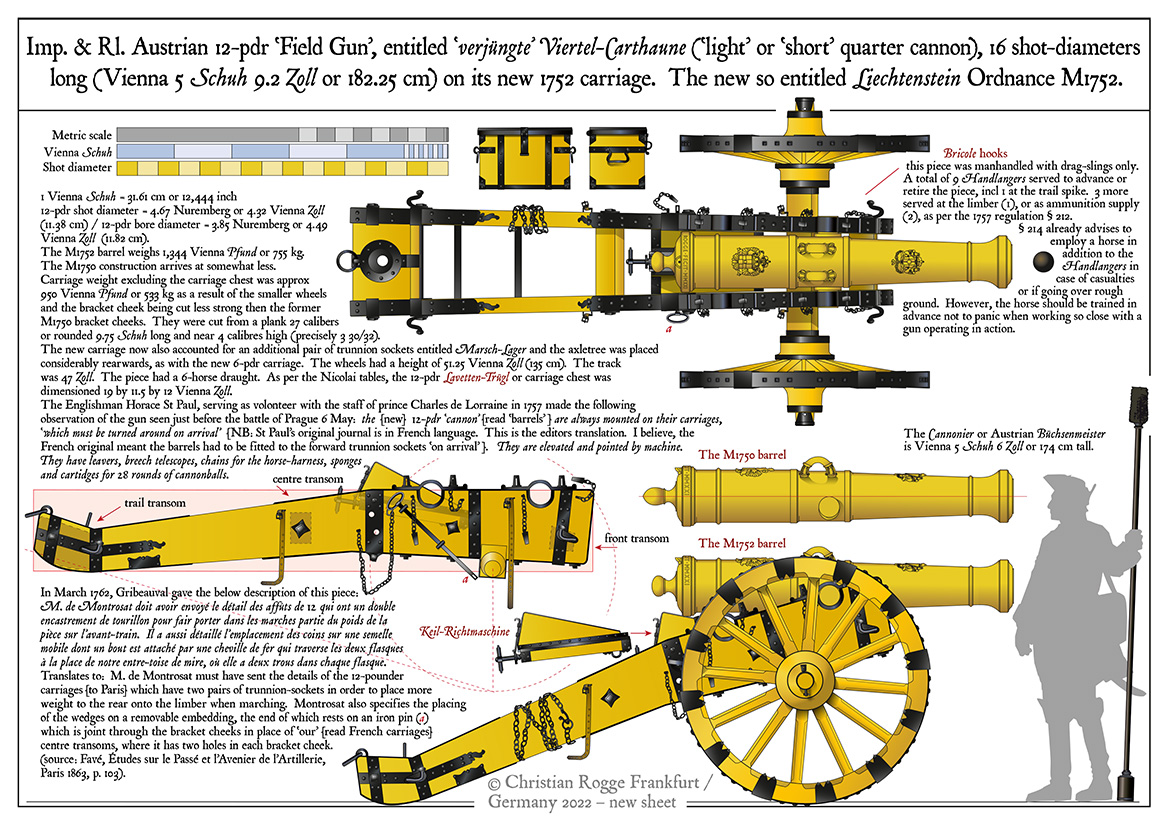
Below I now present the M1752 12-pounder on its new carriage:
 | |||
| Draft of the 12-pdr Field Gun limbered by 1815/1816. Source: Louis van Beethoven Collection Bonn or Berlin, Germany (?) |
The dimensions of the above Napoleonic period piece remaied mostly unaltered. The original M1752 bracket cheek accounted for a length of 27 calibres, while the later construction was somewhat longer. 30 calibres as per the Waffenlehre of 1807, which makes a good match with the above illustration. Also note the difference with the iron fittings. The wheels come without iron straps and also the manner of iron fittings of the bracket cheeks are different to those, found with the earlier models of the SYW period. This 12-pdr is seen with its ammunition box mounted on the limber, introduced only during the 1770's and apparently with different dimensions as the 1752 model.


 |
| Image courtesy Vienna Heeresgeschichtliches Museum HGM, Austria |
This barrel cast 1761 in the Habsburg Netherlands foundry of Mecheln comes with the 1752 Regulation trunnion shoulder design, but also with the 1750 Regulation pine cone shaped button instead of the 1752 Regulation flattened sphere design. It weighs 1,369 Vienna Pfund or 768 kg, which is a close match to the barrels nominal weight of 1,344 Pfund. The barrel length is 181.5 cm measured from the rear of the lowered fillet behind the base ring to the front of the muzzle. A close match to its nominal length of 182.25 cm. Another such M1750 barrel cast in 1768 at the Mecheln foundry you can see below. This barrel has a length of 183.8 cm—the deviation to the above 1761 cast barrel not being an indication to a different design, but the result of this periods standard of pre-industrial fabrication.
 |
| Image courtesy Vienna Heeresgeschichtliches Museum HGM, Austria |
 |
| Image courtesy Vienna Heeresgeschichtliches Museum HGM, Austria |
This one has the 1752 Regulation mouldings but comes with a rather massive non regulation muzzle swell. The ring accounting for a width of 18/32 instead of the Regulation 12/32. Also the dolphins remain not sculptured. Other barrels on display in Vienna and cast at later dates still continue to have the dolphins sculptored as Pratzen. This 12-pdr barrel comes with a length of 182.8 cm.
To complete the 1752 Regulation range of new light field guns, I now present the M1752 7-pounder "Howitzer". This piece replaced the M1750 10-pounder howitzer, which was removed from the range of the regulation ordnance in 1752. However, it is believed it has been added to the range again sometimes during the SYW, since Gribeauval states in his March 1762 report to the French Minister of War, that Austrians fielded 7- and 10-pounder howitzers. The other Austrian howitzer designs in use during the SYW I will present further below along with the range of battery guns.


 |
| Original barrel on display at the Vienna Heeresgeschichtliches Museum |
From 1759 on, also a number of 24-pounders start to appear with the tables of guns fielded with the artillery train of the field army. A total of 6 in 1759, 8 in 1760, and 6 again in 1761 and 1762.
According to Gribeauval’s report of March 1762, it was captured Prussian guns. This piece can be identified as the M1744 super-light Holtzmann 24-pounder presented with the below draft.

Gribeauval writes: « On a mené par complaisance quelques pièces de 24 prises sur l’ennemy; c’etoint des espèces d’obuziers qui étoint sans solidité, sans portée et sans justesse; elles entraînoint une suite énorme de caissons. L’atrillerie a toujours protesté contre; elles n’ont jamais produit aucun bon effet; cependant elles ont été soutenues pendant deux campagnes par les calmeurs des admirateurs des productions prussiens [sic.]. »
Transl: For reasons of complacency, we also have some 24-pounders taken from the enemy; their design resembles that of howitzers; they are without solidity, without range, and without accuracy; they require an enormous number of ammunition wagons. The artillerie corps always rejected them; they never produce any good effect; however the artillery corps opposition had been calmed during two campaigns by our admirers of designs “made in Prussia”. These guns had a 6 horse draught and were served by the same number of learned gunners plus Handlangers as the 12-pdr field guns. This bit being found in the tables of: Beiträge zur Geschichte des österreichischen Heerwesens, part 1: Period of 1757—1814 with particular attention to Organization, Supply, Tactics; Vienna 1872.
Now we come the range of the so entitled “Leichten Batterie-Stücke” (Light Battery Guns). This range, along with the field guns is to be regarded as the genuine new creation of Austrian gun design under the direction of Liechtenstein from 1744 on. The first designs should have been fielded already at around 1745 during the War of Austrian Succession. It is the guns Rubli presents with his manuscript. The other range of Austrian battery guns were entitled “Schwere Batterie-Stücke” (Heavy Battery Guns). The figures for this branches designs of the 1750 and 1752 Regulations reveal, that their dimensions remaind mostly unaltered to the old pattern guns in use since 1716/1722.

 |
| source: Vienna Kriegsarchiv, signature: Memoires XIII/463-465; Franz Rubli. Published with kind permission of the Österreichisches Staatsarchiv, department Kriegsarchiv at ka@oesta.gv.at |


 | |||
| Original draft of the 12–pdr howitzer believed M1737. Source: Württembergische Landesbibliothek/Stuttgart, Germany – Sammlung Nicolai | |
With the below sheet, see the new M1752 field and light battery cannons arranged on a single sheet in same scale.

The next range of Austrian ordnance are the Heavy Battery Guns or "Schwere Batterie-Sücke" as per their official Austrian 1752 designation. It was a 24- and 12-pdr design.


 |
| Original 1750 cast 24-pdr barrel on display at the Vienna Heeresgeschichtliches Museum (HGM) |
I am pleased to be able to present an original M1750 barrel with this article on display at the Vienna Heeresgeschitliches Museum, as well as another 1750 cast barrel as part of the Liechtenstein Princely Collections.
 |
| Source: © Liechtenstein. The Princely Collections, Vaduz-Vienna. Online Archive at https://www.liechtensteincollections.at |
It confirms that the 1750 designed ordnance wasn't produced for testing only, but serial casts commenced right away, as the HGM barrel was cast in the foundry of Budapest and the Liechtenstein Collection barrel was cast in Vienna the same year. All the new guns for testing purposes would have been cast in Vienna, only. The two other barrels seen behind the rather stylish roccoco HGM 1750 cast 24-pdr are M1716/1722 24–pdrs of the old pattern. This gun deserves a closer observation, as it should have been found in service during the SYW. I present it with the below sheets.


I did not bother to do an illustration ot the M1750 barrel mounted on its M1750 carriage. It was basically the same as the one Rubli illustrates.
 |
| Original M1716/1722 24-pdr barrel on display at the Vienna Heeresgeschichtliches Museum (HGM) |
Also see a wonderful 3D animation of a 1724 cast Anton Zechenter barrel with all details:
24-pounder barrel on display at the Vienna Heeresgeschichtliches Museum
This animation is provided with the kind permission of Florian Böttcher/Austria.
Below see another sheet by Frantz Rubli where he demonstrates that the new 18 calibres barrel 24-pdr Light Battery Gun, if mounted on a ship or rampart carriage, reaches as far into the embrasure as the old pattern heavy 1/2 Carthaune mounted on its custom ‘travelling’ carriage (using this periods English denomination here).
 |
| source: Vienna Kriegsarchiv, signature: Memoires XIII/463-465; Franz Rubli. Published with kind permission of the Österreichisches Staatsarchiv, department Kriegsarchiv at ka@oesta.gv.at |
This piece is a M1716/1722 barrel—easy to identify by its eagle designed cascabel and button. As mentioned afore, the old pattern carriages bracket cheeks are about 42 calibres long, instead of Rubli’s 32. The wheels arrive at 64.5 Vienna Zoll or near 170 cm diameter, just like the wheel Rubli recommends with his documented 1737 design. Its total weight including the barrel arrives at 8,946 Vienna Pfund or 5,021 kg while the new light 24-pdr structure weighs no more then 3,550 Vienna Pfund or 1,992.5 kg, as Rubli writes in the accociated captures on this sheet. His illustrated wooden parts of the heavy 24-pdr carriage are coloured near black. I believe he illustrated an older more weathered carriage that has received a furnishing treatment with tar in addition to its initial linseed oil treatment. His other ‘new’ carriages for his new ordnance guns are all illustrated in a much lighter shade of wood brown—i.e. treated with linseed oil furnish only. Somewhat irritating remains his take of the bronze for the barrels. It looks like plain copper, not bronze. Possibly his palette of colours may have lacked sufficient yellow. We don’t know.
Below see also two images of an origninal 1643 manufactured carriage on display at Forchtenstein castle, Burgenland / Austria, as part of the extensive Estherhàzy Armory Collection exhibited here. As said with the afore, it already includes many details seen with the carriages Rubli presents a 100 years later. As far as I can recollect, its the carriage of a 12-pdr. Note the long top face of the bracket cheek from the trunnion cutouts to the bow or angle. It indicates that the carriage mounted a long barrel of around 30 calibres length, or even longer. Please excuse the poor quality of the photos. This piece is on display inside the castles gateway to the inner castle. It was pitch dark here.
 |
| source: Original carriage on display at Forchtenstein Castle, Burgenland / Austria at esterhazy.at/en/forchtenstein-castle |
 |
| source: Original carriage on display at Forchtenstein Castle, Burgenland / Austria at esterhazy.at/en/forchtenstein-castle |
Below find the last piece of the new Liechtenstein ordnance M1752 as well as its M1737 predecessor.


 |
| image source: Ottenfeld & Teuber, Die Österreichische Armee von 1700 bis 1867, Vienna, 1897. |
Above image illustrates what I would identify as a 3-pounder cannon on its carriage limbered during the period of the War of Spanish Succession.
Finally, I present a sheet with two samples of very light guns in use.