06 April 2013

The 2nd Battle of Bergen – Easter Friday, WWIII Central Front 1985

Here are a selection of shots taken from our Easter Fridays Game. Odd purists may object the scenario won't fit in this dedicated Seven Years War Blog, but, I must say it does bear a compelling connection, really. That's why I chose to share it anyway.
Soviet T-80's attacking


To me and our group in Frankfurt/Germany, Easter Friday has been the anniversary day of the SYW April 1759 fought battle of Bergen for years. This year, I made it a "Cold War turned Hot" scenario settled in around 1985-86. 
A Soviet reinforced tank regt (T-80's & BMP-2's) supported by 4 flight's of Mi-24 Attack-helos under the command of colonel “Brunswickov“ launched a deliberate attack on a NATO W-German battle group under overall command of a W-German general-major named "Breugler", drawn from 15th Armoured Brig/5th Armour Div with Leopard II & Marder IFV's (each 1 reinforced battalion plus 1 AT coy Jaguar II HOT and a battalion of 155 mm SP howitzers). NATO defended the high grounds to the east of Frankfurt - in fact the historic grounds of the 7YW battle of Bergen in 1759. Recon and AA platoons were also included on both sides. 
A great battleground to the present day, as it turned out. Google maps provided the basic layout for the terrain. Worked excellent. An embarrassing lot of build-up-areas, rally. I need more buildings, I guess.
The Terrain (table size 2 x 1.9 m)
View shows end result with initial FEBA outlined red


For my scenario, I used the original set of Frank Chadwick's Combined Arms rules (long out of print) which I haven't played for years. Yes, it's still alive. I wonder if anyone else is still using this set of rules?

My Scenario Planning
We were 4 players. Two on each side. I played on the WarPac side. 
NATO mission: Hold and defend
Part of the W-Germans were supposed to start in prepared positions, while a reserve of armour was to reinforce only later entering from NW direction of Nieder-Erlenbach.
Bergen-Enkheim and Bad Vilbel surroundings seen from the South

WarPac Mission: seize Bergen and Lohrberg heights
The Soviets approached from E on two axes. Most armour plus 2 Mot-Rifle coys approached from Schöneck while a Mot-Rifle bataillon approached along the A 66 Interstate tasked to seize Bischofsheim and attack NATO positions along A 66. 1st Bn/28 Armour following behind and tasked to assault Bergen from front the minute the northern group started its assault across the heights just S of Gronau. A single massed simultaneous strike was planned. That should do it, I thought. Part of NATO positions to the W of Bischofsheim were to be blinded by smoke to reduce defensive fire, to be delivered from the Regt Arty group of 3 battalions deployed behind the Hohen Stein high ground (each 1 bn SP 122 mm and 152 mm howitzers and 1 bn BM-21 missile launchers).
Soviet 3 bn Arty Group deployed to support the attack

Forward Edge of Battle Area (FEBA) was found by a pre assault recon action by all players operating with a company sized force to get a feel for the rules. The positions gained here could then serve to place forward elements onto the table. This, I did for the first time. To my feeling not so bad an idea to play out a prior mini game simulating the pre main action recon part, and then start the real game anew. It helps to avoid having an entire Arty battalion gang up on a single unsuspecting BRDM recon platoon the moment it comes into sight. I had all this in other games before.

How did it all work out?
Very different to my initial planning. The W-German reinforcing armour elements choosed to be already in position instead of coming in later. I somehow missed to tell this bit right after issuing the troops to my opponents. Soon later, while I was busy explaining our force to my partner, they had all deployed & I didn't bother to interfere. The heck. Won't make much of a difference, I thought. While the Soviet were deploying for the assault, W-Germans launched a smallish spoiling attack on Gronau, held by only a single BRDM recon platoon. Soviet plans remained unchanged, nevertheless, except Gronau was now also to be regained, which absorbed about 2 coys strength. Gronau now became the scene of a murderous close combat with both sides arty elements also joining in.
The fighting in Gronau
Soon later, 3 Soviet tank bataillons started the assault head on the Bergen position. I failed to fire the planned smoke mission, but instead decided to attack several spotted enemy with regular HE. Not a good decision, as it turned out, for it did little damage. Now basically all W-German elements in  position opened fire on Soviet tanks. The result was an outright massacre.
Too many tanks now received hit into their flank armour from the direction of Gronau and South positions in the woods behind Bischofsheim (the area that was to be blinded by smoke). This brought the game to a soon end with the Soviets taking a decisive defeat. Our Mi-24 Helos now could do no more then cover our retreat.
Finale seen from the South
W-German positions in Bergen. Most being 2/152 PzGrenBtl. – the unit I served in between 1984-1986. It suffered no casualties. I must have survived the day, I guess :-) 
W-German M-113G A2 artillery Forward Observer. The model being a self-made conversion

10 January 2013

Prussian SYW Artillery scale drawings – part 2


In order to illustrate Prussian ordnance of the Seven Years' War with its true distinctive features and dimensions, it is necessary to have a look at the 1717 designed ‘new range’ of ordnance, which laid out most of the basic characteristics of all that can be entitled distinctive Prussian in relation to other nations ordnance for the decades to come. The below two sheets have been arranged to give an insight here.
I took the effort to also illustrate the 3-pounder field gun, for it is believed some pieces to this design did see service during the Seven Years’ War, despite being obsolete ‘old school’ by that time. The next sheet will give some insights to the general design of the carriages. I am particularly happy to have unearthed an illustration of the M1717 wedges (Schusskeile). The design is explained in Malinowsky & Bonin, but only with another rare paper authored by Malinowsky, the so much needed illustration could be found. The written description, only, with its many outdated technical terms was found impossible to understand. Source is the periodical Archiv für die Officiere der Königlich Preußischen Artillerie- und Ingenieur-Corps, vol. 8, Berlin 1839. The Darmstadt State- and University Library keeps a copy including the appendix foldouts that are missing with the Google library copy. I hope my English wording is ok. Any corrections and improving suggestions to English wording of the technical terms are highly welcomed. I’m no engineer.

This carriage design remained in use till well into the Seven Years' War. The carriages were furnished blue, and the metal fittings were painted black. The tools and other equipment, such as rammers, wedges, etc. were instead furnished odd grey. Constructors and cartwrights kept modelling about with minor details throughout the period, but in general, this is how the guns looked like. The paired spokes arrangement was found with the 3- and 6-pounders. The heavy guns had wheels with spokes in ordinary arrangement. Only during the course of the Seven Years’ War, a new carriage design seemed to have been introduced. I will get back to this issue with the sheets to come. For the period up to 1759 and beyond, Prussian carriages looked as illustrated. Below, I added a contemporary illustration of the M1717/1722 3-pounder, found in a gunners’ manual dated approx. 1745 (source is the collection of the Rastatt Army Museum/Germany).

This carriage is of the M1717 design, but with bracket cheeks overall 5 D longer than my above illustration (+1 for the trail and +4 for the centre section [Z]). My illustration is based entirely on the details from Malinowsky & Bonin.
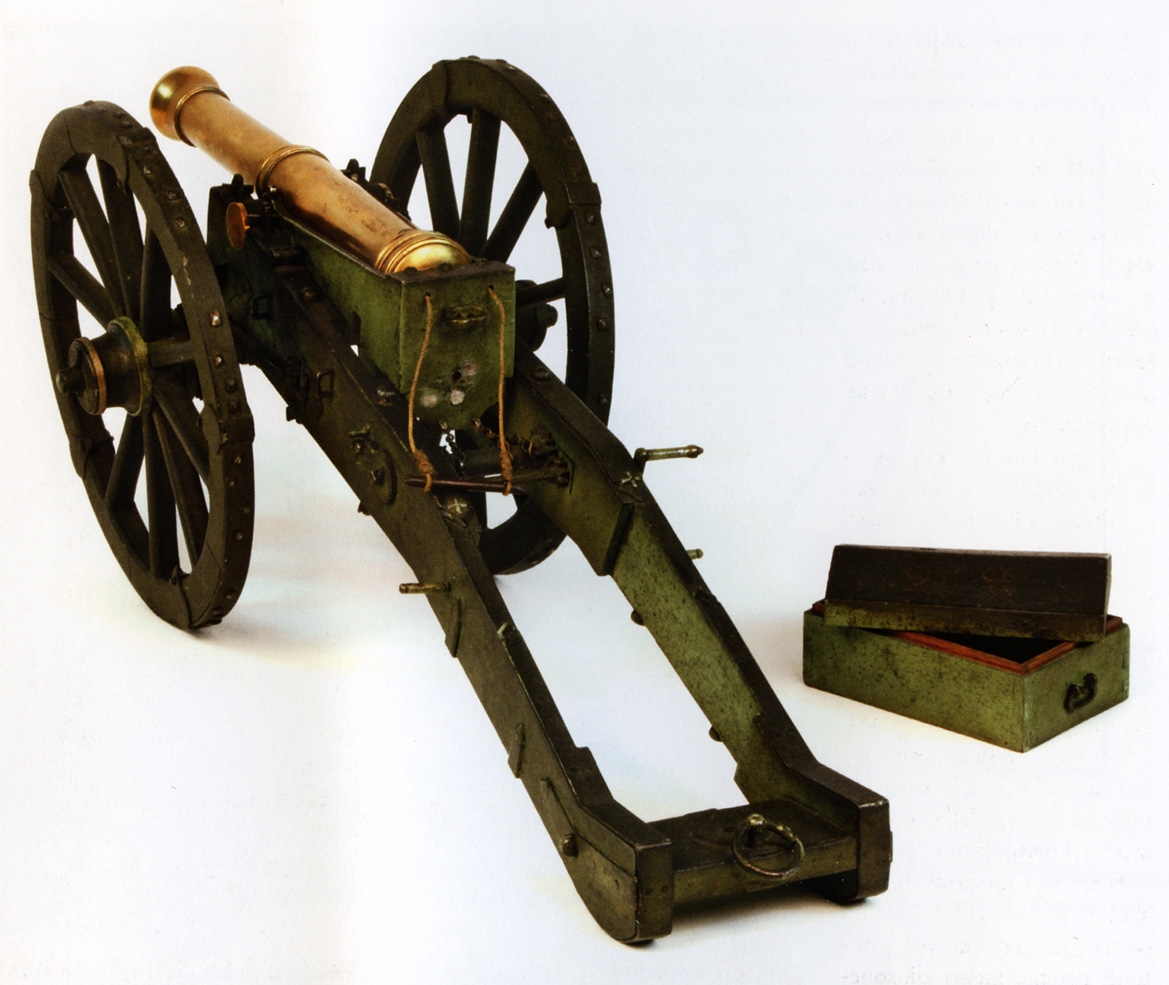
The below photo shows – to my understanding – the single original Seven Years’ War carriage that survived to the present day.

Its a 2-pounder piece of 1758 and belongs to the collection of the Stockholm Army Museum / Sweden. From Hans Bleckwenn’s, Die friderizianischen Uniformen 1756 - 1786, we learn only this single piece was fielded – i.e. a solitaire non-royal ordnance design. The barrel was cast and its carriage assembled in Stettin. It was the private effort of a captain von Seebach in an attempt to equip his militia bataillon with a cannon. Apparently, the king refused to give Seebach’s unit a piece of his own royal ordnance. It was soon lost in a combat against the Swedes. Bleckwenn also provides the scale drawing to this piece. I don’t know the origin of Bleckwenn’s sketch, so that I cannot tell the hen from the egg. The sketch, at least, does give us the dimensions.

Most details of the carriage make a good fit with afore described M1717 carriages. Just the non-rounded trail and the use of only a single horizontal bolt near the centre transom deviate from the regulations. Also the wedge design is somewhat special.

From 1738 on, a significant transformation in Prussian gun construction took place. Prussian field cannons became much lighter, thus, more mobile than the M1717 heavy ordnance. This was contrived by reducing the charges, overall barrel length, and metal strength of the gun tubes. 


The Holtzmann 24-pounder served as master-design to which all other calibre pieces were to be proportioned. Several variants seem to have been cast and tested between 1738 and 1744, for the records give several different overall barrel weights for the pieces actually fielded. The below image from the Gohlke booklet served as the template for my illustration.  

It took me a while to realize its caption is complete nonsense. The drawing is absolutely fine, and accepting it is really the 16 shots 24-pounder all dimensions start to make a lot of sense. The signifficant reduction of weight is quite obvious compared to the older early 18th century European standard ordnance illustrated with the two sample barrels. The new design was based on the widespread believe a chambered bore design created much more gas pressure to the round then an ordinary bore design. Based on this observation, Prussians concluded one could arrive at the same power with less charge. Less gunpowder also allowed for the reduction of the barrels metal strength. This way, the same number of guns could be fielded at much less cost, or alternatively, the number of guns could be increased at same cost. Indeed, a best price arrangement hard to resist, for it so much suited the only now evolving Prussian battle tactics. Prussian infantry drill had arrived at outstanding battlefield mobility. All that was missing was a numerous and equally mobile artillery for best close support. Frederick was so enthusiastic about these light pieces, that within a decade, all of the old heavy ordnance was rigorously melted to provide the gunmetal for new casts, or expelled to the arsenals to serve as fortress or siege cannon. By 1756 all Prussian field guns were chambered bore pieces of mostly 16 shots length, a new 12-pounder 14 shots long, and a super light 24-pounder only 12 shots long. The Beauvrye 3-pounder (see below) was the single ordinary bore design remaining, and it can be considered the master design of yet the next transformation of ordnance to come.
The below sheet examines such a light chamber bore barrel design in somewhat more detail. I felt the need to have a closer look, do a very close reading and recreate the true dimensions. The date of introduction varies with the sources. Apparently, the guns were designed in 1738, but first serial casts commenced only in 1740.


Bataillon Guns


I will try to focus on those guns that were most important either for their design or because they were fielded in larger numbers. No less than six different models of 3-pounders were fielded during the course of the war, including the old M1717 piece as well as around 38 Saxon "Quick-Firer" barrels captured at Hohenfriedberg (1745) and adapted to Prussian style by end of 1750. Captured Austrian models are not included here. For easier identification, all pieces – i.e. more precisely the barrels – are commonly named after their designer/constructor along with the date of construction and/or its first serial casts.

On the eve of the war, summer 1756, Prussians mobilized 240 bataillon guns for a total of 126 bataillons (incl. Pionniers and some bataillons tasked for garrison duty not issued any pieces). 62 were newly cast 6-pounders replacing the same number of Holtzmann 3-pounders with a cylindrical chamber bore. The remainder were all 3-pounders. In terms of numbers, the Holtzmann M1740 conic chamber piece was the most common, amounting to near 100 out of the 178 total. Its new and particular light construction replaced the heavy M1717 long barrel pieces from 1740 on. The construction was indeed found to be too light as the campaigns of 1744/1745 revealed. Its' shot hardly carried 1.000 paces. With the widening of the chamber in order to take a larger powder charge, its shot now carried up to 1.500 paces. Nevertheless, after 1745/47, no new pieces were cast to this model, it seems. New designs were given the preference instead. One such new design was the Beauvrye M1746 piece, which seems to have been designed in response to the shortcomings of the Holtzmann M1740 piece. It had a longer barrel, but was still much lighter then the old M1717 piece. From this model, only 18 casts at the Berlin foundry are documented. Some more pieces may well have been cast, for these tables are incomplete, but this model was fielded in much fewer numbers as the Holtzmann piece. Also in 1746, general Linger designed a conic chamber barrel 20 shots long and somewhat lighter then the Beauvrye piece. Apparently, now this new Linger model was given the preference, as around 60 pieces are believed being cast up till 1756. The light barrels seemed to have been mounted on an equally lightened carriage. Bracket cheeks were shorter, and also the wheels were scaled less high. The illustrated 42 inches wheel is based on the Beauvrye piece illustration found in Gohlke, Geschichte der gesamten Feuerwaffen bis 1850. The Holtzmann 24-pounder had 51 inches wheels. Therefore the 2 remaining 6 and 12-pounder calibres must have had wheels scaled between these two extremes. See also below near contemporary painting “Seydlitz at Rossbach”.

The gun seen here can be identified either as the Beauvrye or the Linger 3-pounder. The uniform details look all rather authentic. The cannon may well be just as authentic. Note the gunners ‘flail-rammer’ as well as the bricoles slung around the gunners’ shoulders. This gun also comes with rather small wheels.
The Beauvrye piece is of interest because according to a paper by Hans Bleckwenn it is quite certain that it was attached to the Berlin region infantry regiments Prinz Heinrich (IR 35), Münchow (IR 36), Fredericks' own Praetorians ( IR 15/I. Leibgarde), and possibly also the other Guards bataillons in 1756. They had them with all their Potsdam exercises during the early 1750’s, as it is recorded in a diary of the Guards officer von Scheelen (see: Hans Bleckwenn / Engl. translation by Digby Smith: Prussian Field Gun Models in Relation to General Tactics. Original articles in the Zeitschrift für Heereskunde, 1957, Numbers 154, 155, 156, 157. 1958/1 Jan-Feb.)
Above we see another battalion gun from the period of approx. 1700. Also with rather low wheels. It's an original Bavarian 1-pounder (caliber approx. 5 cm). It is in the current exhibition of the Bavarian Army Museum at Inglostadt. I haven't bothered to make elaborate measurements. The wheels have a height of less then 90 cm. My friend A*** is serving as ambulant scale reference. He is 184 cm tall (including his missing head:-)) The barrel should be a 27 or 30 shot class barrel or approx. 135 or 150 cm long. A very popular length for 1 or 2-pounder pieces of this period.
As I am discussing the Prussian range of early Seven Years’ War bataillon guns, this chapter can be completed with also presenting the M1754 light 6-pounder by Dieskau.


Holtzmann’s M1740 range also included a 16 shots 6-pounder, but only few have been fielded during the campaigns of 1741 and 1742. It was only little more effective then the 3-pounder but requiered more horses for it’s draught. For this reason it was removed from the field inventory. The remaining Linger 3-pounder had a 20 shots barrel (144 cm) and should have looked much like the Beauvrye piece.

The sole type of bataillon gun not disscused being a 1-pounder Amusette. Such a piece was initially allocated to the Prussian Frei-Bataillons raised during the Seven Years’ War at a ratio of 1 piece per bataillon. From 1759 or 1760 on, they all received 3-pounders instead. Moreoften captured Austrian pieces. Little information could be found here. The first pieces used were really captured Saxon models found in the arsenals of Dresden and Freiberg. With near certainty, the carriage was a `wheelbarrow` type, in which a horse could be harnessed between the shafts. This type of carriage was known all across Europe and fielded with many armies. In Britain it was entitled Galloper gun.

Also of interest may be the innovative limbers, that came with the Prussian bataillon guns. A combination of limber and ammunition cart.


Position Guns

In 1756, and all through 1757, Prussian heavy or ‘Position Artillery’ consisted of chamber bore 12-pounders, either 16 or 14 shots long, and a super light 24-pounder. Furthermore several 10/11-pounder howitzer models. The first sheet presents the 16 shot barrel 12-pounders.

Once more an image of the ‘real pieces’. Above image shows a number of barrels on display at the Vienna Heeresgeschichtliches Museum (HGM). No 1 is a Dieskau M1759 ‘Austrian-type’ 12-pounder, 18 shots long. A cast of 1781 it seems, as per the little information I was able to aquire from the museum. This would be confirmed by the shape of the rounded button which started to appear with casts of 1774 and later. No 2 could be identified as the M1758 ‘Austrian-type’ 12-pounder. A 16 shots barrel (182 cm) Apparently a cast of 1758. It's weight, as per the barrel's engraving is 1,680 pounds (785.4 kg). No 3 behind is a Dieskau 6-pounder M1768/71, 18 shots long (or more preceisely 18.2). Again a cast of after 1774 because of it’s rounded button. This piece came without holds/griffins. And to the rear No 4 we have a mighty 24-pounder. As per it’s mouldings, the piece should be either M1754 or the earlier M1717. Both were quite similar. No 5 is an Austrian 6-pounder. The non sculpted holds and the rounded button would also make it as a 1770 or later cast. The barrel in the left foreground is a Russian Unicorn (date of cast unknown). the bore is larger then the Prussian 12-pdr next to it. Should be a 15 cm class calibre, roughly equalling a 24-pdr bore. As one can see with this rather random arrangement of barrels, the Prussian barrels do have a presence of their own, and do stand out from the crowd by the sheer size of the sculpted griffins. In particular the 24-pounder looks awesome.
The next piece I like to introduce is the rather special design ‘super-light’ 24-pounder M1744. The below draft is the 2021 revised illustration of the piece based on original source. As a result, my earlier 2013 presented piece is now somewhat obsolete, especially with regard of the barrel design. The revised barrel construction can be found in my article Prussian SYW Artillery Scale Drawings – part 4 – from 04 January 2016.


Next to the 12-pounders, this piece, along with the equally eccentric 10/11-pounder ‘howitzer-gun’ designed the same year were meant to be the mainstay of the Prussian ‘heavy’ field artillery with the early Seven Years‘ War campaigns, all through 1758. Both were fielded for the first time with the Prussian invasion of Bohemia in 1744.
The 24-pounder is said to have done particular good service at the battles of Hohenfriedberg (1745) and Roßbach (1757). From 1758 on, it gradually became out of use, as it was replaced by the introduction of a new range of more powerful 12-pounders. Next is the 10/11-pounder ‘howitzer-gun’. Both pieces just belong together. They have been designed the same year, and their special construction, along with Holtzmann‘s Klemmkartätschen entitled grape rounds – especially designed for these two pieces – can be deduced only from an understanding of their intended tactical employment. 
Frederick was a great promoter of cannister and grape, in favour of ordinary shot, to be employed with the guns in a given action. To his observation, with the early Silesian Wars‘ battles, cannister and grape did far more damage as roundshot. But cavalry could not really be harmed with conventional cannister rounds at medium ranges. It was the Austrian cavalry, that had been the biggest threat to the Prussians in the battles of Mollwitz 1741, and Chotusitz, 1742. This shortcoming of Prussian 1740 ordnance must have been the inspiration to create a range of ordnance capable of firng destructive grape rounds out to longer distances. The naked figures expressed with the two illustrated barrels leave no doubt to the intention of their design. Frederick‘s 1749 tactical instructions gives the most evident hintsight. He advised to place a battery of 4 24-pounders and 4 10/11-pounder howitzers on the wings of the infantry line. From this position they were tasked to aim at the oposing cavalry in particular by employing Holtzmann‘s Klemmkartätschen.
In addition to the long barreled 10/11-pounder howitzer, also shorter barrels of approx. 6.5 D length were designed.


Above image shows a Prussian 10-pounder howitzer barrel on display at the Vienna Heeresgeschichtliches Museum (HGM). It should be the 'heavy' M1766 for the siege artillery, which is revealed by the rather massive dimensions of the first reinforce. The barrel was approx. 6.5D long (108 cm).


Of less importance is below 18-pounder. The principal howitzer piece of the pre-1740 period. The last 10 pieces to this design were cast at the Berlin foundry in 1744, it seems. A few were mobilized during the SYW. However, the mainstay of howitzers was the 10 or 11-pounder during the early campaigns and the light 7-pounders fielded in growing numbers from 1758 on.


I needed to do the piece in order to understand the method of proportioning a howitzer carriage in relation to it‘s barrel. Most turorials of the period simply state they were quite similar to the proportioning of a cannon carriage, and that would be about all that is said. Also below illustration is part of this research work. It is based on the single draft of a Prussian howitzer, I was able to find. In fact, 2 such pieces must have been part of Feld-Maréchal Lehwaldt‘s East-Prussian Corps of 1757 – after the battle of Groß-Jägersdorf – as replacement of the 10-pounder howitzer pieces lost in this battle.


more pieces to follow …

16 June 2012

7YW Artillery – the Prussians are coming

I finally managed to get started with the Prussian ordnance fielded during the Seven Years' War. It is a most interesting subject to me, for there is so little image material found with the commercially available books on the Prussian army. Even with rare ones, long out of print. 
I'm so fond with the first results, that I thought of sharing it in advance.
The below first illustration, therefore, is a sort of sneak preview, as I worked off-scale my regular sheet format. More details are to follow with my next completed sheet.

More information on Prussian artillery will soon be available in English language published in the Smoothbore Ordnance Journal by Digby Smith and Stephen Summerfield. Digby Smith has also done a wonderful translation of a rare paper by Hans Bleckwenn focusing on Prussian 7YW artillery.

At this point I wish to thank all who have supplied me with this wealth of material. I have received great support from many countries ranging from the US, UK, Denmark, Italy, France, and Germany. I have also received the official permission of the Stockholm Army Museum to use their image material.
My initial decision, to do this project in English language rather then in German turned out to be a good one. The audience grows so much larger.
My special thanks to David Morfitt ("Not by Appointment" Blog at nba-sywtemplates.blogspot.de ), who has contributed the nice illustrations of the Prussian barrels and carriages insignia.
Regarding the 'source situation’ on Prussian artillery which enables me to reconstruct the 7YW period pieces, I will draw most heavily on the single most valuable 4 volume work by Malinowsky & Bonin, Geschichte der brandenburg–preussischen Artillerie, vol. II, Berlin 1841. It provides most detailed descriptions on the evolution on barrel and carriage design, but comes without images. Regarding images, most authors work with the same four of five illustrations again and again, which implies not much has survived WWII. The former Berlin Zeughaus Museum owed a large collection of scale models of which but few pieces survived. Also the Potsdam Heeresarchiv had loads of scale drafts of about all pieces ever fielded or designed in Prussia. All was lost with a devasting air raid April 1945, it seems. Some scale drawings did survive in Germany or other collections, such as Denmark. Most are post 7YW, but are of good help nevertheless. 
To make matters worse, some glaring errors are found with correctly identifying some of the images. None of the more recent Historians such as Dr. Hans Bleckwenn, Die fridrizianischen Uniformen, Osnabrück 1987; or Martin Guddat, Kanoniere Bombardiere, Pontoniere, Herford 1992 seem to have noticed. The flaws start with the 1911 published little booklet by Gohlke, Geschichte der gesamten Feuerwaffen bis 1850. Gohlke comes with 3 sample images of Prussian guns. Two of the three have false captions. Bleckwenn, at least, was more cautious with presenting his 12-pounder illustration "claimed" to be mounted on a M1762 carriage. Martin Guddat less so. He presents several images of a 12-pounder scale model, a black and white photo of another 12-pounder unlimbered and a 24-pounder limbered, and fails to notice that it is all different photographs of the same piece. It's a scale model of the "Austrian-type" 12-pounder designed by Dieskau in 1759, 18 shots long, and mounted on a M1774 carriage. Bleckwenn illustrated the piece in his book. The barrel design is equally the model for the casts of 1774 or later. The carriage is of similar design as with the heavy 12-pounder nicknamed "Growler" (German: Brummer) on display at the Paris Musée de l'Armée to the present day. A barrel 22 shots long and first cast in 1761. The famous "Growlers" first fielded at Leuthen in 1757 were heavy fortress or siege guns with 24 or 26 shots barrels, not the model on display in Paris. It's dimensions was rather close to the French Vallière 12-pounder found in my January 2012 post.

17 May 2012

7YW Artillery – part 5 – SAXE-POLAND


With the below, I will introduce another rare mid-18th century cannon of which–to my knowledge–very little information so far has ever been published, not to mention anyone has published an image of its general design and dimensions.

Original Saxon source could not be found, unfortunately. Instead, a set of original scale drawings can be found at the Torino / Italy Museo Storico Nazionale di Artiglieria illustrating a piece called ‘Canone alla Sassone’. The museum also has a scale model. All is dated approx. 1755. An original Sardinian–Piemontese 1757 cast 3–pounder barrel with near similar dimensions as my illustrated Saxon 3–pounder barrel is on display at the Vienna Heeresgeschichtliches Museum (HGM). The museum labels it as a 4-pounder. Its caliber is 77 mm. Shot diameter should have been approx. 72 mm, which clearly makes it a 3-pounder to my understanding. The barrel has a length of 1,44 m. This barrels mouldings in particular the muzzle design matches those of the scale model at the Torino museum but doesn’t match those of the scale drawings. Also the scale drawings carriage bears some deviations to the design of the model. I believe those scale drawings to be a copy of the original Saxon piece that served as master for the Piemontese pieces fielded till 1796.
Original scale drawing to be found with the collection of the
Torino Museo Storico Nazionale di Artiglieria, Italy
Next to this, there exists also an illustration of a Prussian prototype 3-pounder cast and assembled with its carriage in Berlin 1746 by the Saxon-Polish major Oettner (found in Gohlke, Geschichte der gesamten Feuerwaffen bis 1850, Leipzig 1911). The piece was tested but failed to attract the kings’ interest. Its illustrated barrel looks near similar to the Torino drawings. It also comes with the general Obmaus designed ‘Richt- und Lademaschine’ [Engl: ‘pointing & loading machine’]. Franz Karl Obmaus – elsewhere also Obenaus – was a Saxon-Polish lieutenant general †1735.
Illustration found in the Gohlke booklet. Note, Gohlke fails to identify it correctly and presents it as the original M1732 Saxon piece. It is with near certainty based on the draft of the Oettner M1746 piece proposed to the king of Prussia. Around 1900 part of the Berlin Arsenal Museum collection.
From other mostly scattered German language notice we know the Saxon M1744 3- and 6-pounder pieces were designed 20 shots or calibers long, had a conic chambered bore, and a weight of 380 and 530 pounds (180 and 250 kg), which makes them rather light. The barrel length/weight ratio implies they must have been proportioned with reduced metal strength. This detail makes a very good match to the Torino museum scale drawings which present a 20 calibers barrel with a conic chambered bore and  3/4 solid metal strength barrel walls (18/24 descending to 7/24 partes at the front of the muzzle). This makes for its rather slim silhouette compared to the much shorter, but heavier Austrian 6-pounder M1753 weighing up to 800 Vienna pounds (414-440 kg).
Barrel design of the original scale drawing found with the collection of the Torino Museo Storico Nazionale di Artiglieria, Italy
This Saxon cannon belongs to the class of the so entitled Einfallendes Geschütz [Engl. lit. ‘dropping cannon’]. This entitlement derives from this guns alternate method of loading, as well as laying it anew. For loading the piece when engaged in quick-firing canister, the gunner would place the ready cartridge round into the muzzle, and with the special design of the Obmaus ‘pointing & loading machine’ replacing the wedges and centre transoms of the carriage, the barrel would be unlocked from its horizontal position and drop down rearwards till it was stopped dead by the axletree. With the illustrated carriage design approx 65° position. The round would now place itself automatically without the need to employ a rammer. Thereafter the barrel was pulled upwards and latched into its previous horizontal position by means of a T-handle with a rope fixed at the barrel’s rear and the gun was ready for the next discharge.
Scale model of the Cannone alla Sassone  fielded by the Piedmontese army found with the collection of the Torino Museo Storico Nazionale di Artiglieria, Italy
Prussian sourced notice tells us the guns could fire at a rate matching ‘the rang of the church bell’ (see Gohlke, Geschichte der gesamten Feuerwaffen bis 1850, Leipzig 1911). However, the idea behind it was more for safety concerns rather then a further increase of the rate of fire. The term Geschwindstück [lit. ‘quick-fire piece’] alludes to a bataillon gun and its employment for quick or rapid canister fire under close range fire conditions first introduced by the Swedes sometime between 1700 and 1710, to my understanding. Conventional methods of loading bore the lethal risk of the new round accidently going off while ramming the charge down the barrel. For this reason, the crooked rammer was introduced which allowed the cannonier to ram home the cartridge while placed outside the firing line. In case the round did go off he would now only forfeit his rammer rather than his life. Apparently, this sort of unintended ignition happened all too often, which must have made some unknown Saxon philanthropist invent the concept of the ‘dropping barrel’ for loading.
M1766 post SYW 4-pdr ‘Quick-Firer' in loading position.
The barrel was 16 shots long and designed much similar to
Austrian pieces fielded then. Carriage and somewhat modified Obmaus machinery for aiming and loading continued to be in Saxon service up till approx. 1812
Source is the image archive of the Nurnberg Museum, kindly forwarded to me from Rome, Italy

The design is indeed said to be a Saxon invention. The date of first introduction could not be ascertained. By 1728 light 2-pounders were fielded. This we know because in that year king Augustus the Strong made a pair of these guns a present to the king of Prussia. It was the forerunner of the 1734 introduced 3-pounders fielded with the Obmaus machinery. The M1734 pieces had barrels with a length of 21 calibers or shot diameters. From a Prussian sourced paper on ammunition transport we also know the Saxon Geschwindstücke were drawn with limbers containing an ammunition box (German: Kastenprotze – see Archiv für die Officiere der Königlich Preußischen Artillerie und dem Ingenieur-Korps, vol. 11, Berlin 1840). It must have been among the first pieces with this new concept of ammunition transport.
Original Piedmontese barrel on display at the Vienna Heeresgeschichtliches Museum.
Cast by the famous founder G.B. Gabone in Torino 1757.
The Saxon ‘Quick-Firers’ first test in battle seems to have been a rearguard action known as the Combat of Radojovaz, Serbia, 28 Sept. 1737. The relation of the army’s commanding Feldmarschall Khevenhüller notes it was the Saxon Geschindstücke in particular,  that decided the action for the Imperials because of their sustained rapid [canister]-fire which had such devastate effect against the densely packed Ottoman hordes attacking and bent on capturing the Imperial army’s grand baggage (found in Streufflers Oesterreichische militätische Zeitschrift, vol. III, Vienna 1828, p. 347.) The same pieces were also fielded during the First Silesian War with the campaigns of 1741 and 1742. In 1744 new pieces were introduced with only 20 shots length. Now also a 6-pounder Geschindstück was designed. This is the piece I have reconstructed with my above illustrations. As the Prussian records of captured pieces imply, 3-pounders only were fielded in the battles of Hohenfriedberg, (4 June 1745), and Soor (30 Sept. 1745). With the battle of Kesseldorf (15 Dec. 1745) also the 6-pounders were fielded. With this battle the Prussians had a taste of their performance. A good number of 6-pounders along with heavy battery guns were deployed around the village of Kesseldorf, the objective of the Prussian right wing attack. The initial attack was repulsed because of the defenders murderous canister fire, it is noted. It was the mindless counter-attack of the defending Saxon grenadiers that gave the Prussians a chance for a second try. Also the attack of the Prussian left onto the Saxon held high grounds nearly ended in defeat once more because of the very deadly Saxon artillery fire.
By 1756, a total of 50 6-pounders were found with the Saxon army in its entrenched camp of Pirna. All fell into Prussian hands with the Saxon surrender. A total of 46 was found undamaged and these pieces were issued to the Saxon infantry regiments that were now incorporated into the Prussian army. It seems, too many of the original Saxon cannoniers preferred to leave Prussian service to enlist with the newly formed Saxon army in Hungary so that by the start of the 1757 campaign no gunners were found that knew how to serve the Quick-Firers. From Prussian source we know these pieces never took to the field, the former Saxon bataillons were equipped with Prussian 3-pounders instead.
To complete this article, I guess, one more word should be added to answer the question, likely to be raised - why did this apparently innovative and effective weapon not find wider introduction?
We know, this type of cannon was fielded only by Saxony and the Kingdom of Sardinia-Piemonte for any longer period. Also the Spanish National Archives have a scale drawing, dated 1760, illustrating a carriage of a much similar piece. As per its descriptions it was fielded by the Neapolitan army then. The entire construction was certainly more costly then a cannon fielded with the ordinary design. This may have been the reason why the large military powers of Europe rejected it. The fact that it was introduced in Saxony and Piemonte, two of Europes' most affluent countries, and both with only a smallish army would support this suggestion. In technical terms, it was said the machinery had the disadvantage that any light damage to the machinery suffered in action would disable the piece.