Showing posts with label My 1760 French vs Allies "Near Battles" being fought. Show all posts

29 June 2016

The Action of Volkmarsen*** 24 July 1760 – The Day of the Light Troops

Here is my next game – another Scenario, based on my 1760 Summer Campaign in Lower Hessen with its French versus Allies historic unfought ‘Near Battles’ being fought. I must say, so far, my project has turned into a nice ‘scenario generator’ producing great games in multiples. This time it’s the Action at Volkmarsen on the Twiste rivulet. 

The French army passes the village of Külte.

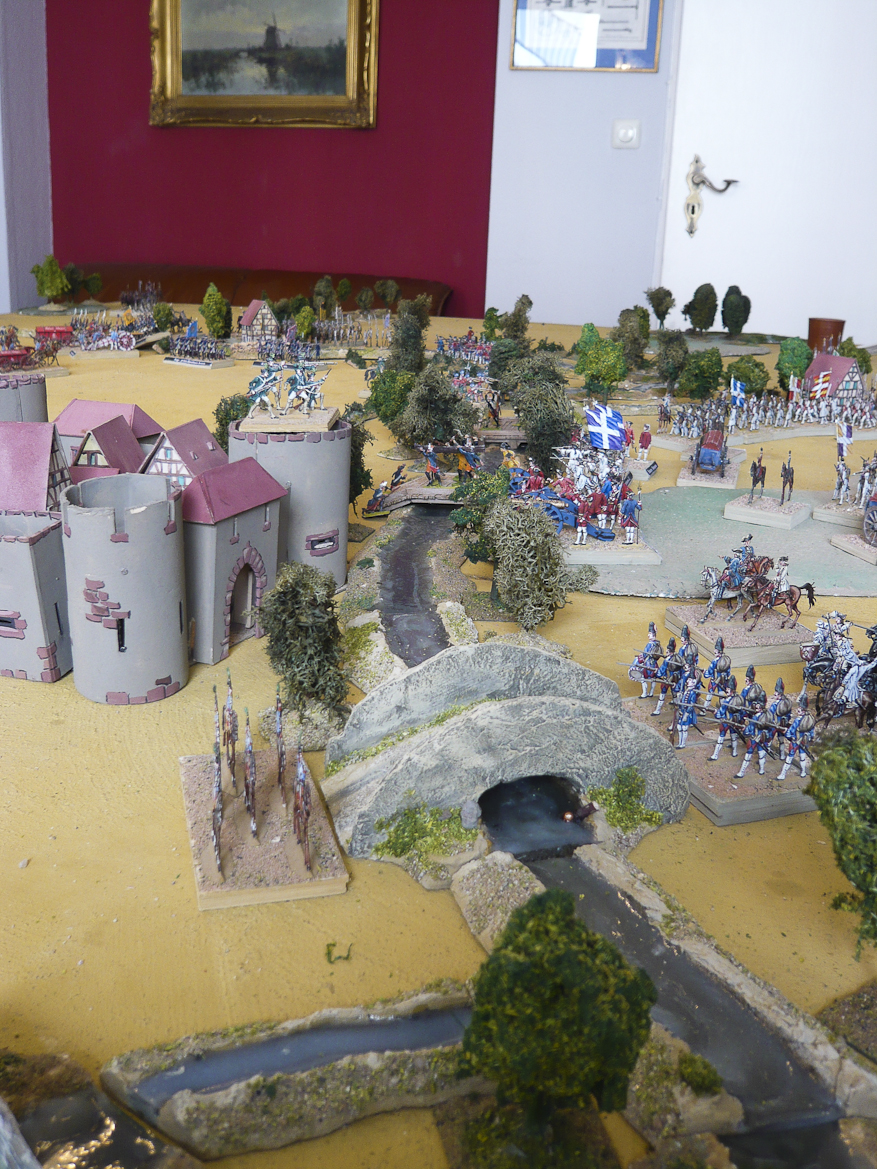
The French army closes in on Volkmarsen, the walled town seen on the banks of the Twiste rivulet.
I simply follow French maréchal Broglie’s plan to tour the landscapes or regions of the Grimm Brothers fairy-tales with his 1760 summer campaign. I do not want to detract from the great work of the Brothers Grimm, but I find it so compelling to add my own imagination in the wake of Broglie's progress within the lands Grimm's fairy-tales. The Hesse-Waldeck region really is the home of the Snow White tale. The historic Snow White is believed to be based on the story of an ill-fated love affair of a young exceptionally pretty and brilliant Waldeck princess with young Habsburg/Spanish prince Phillip – later Phillip II – at the court of Brussels. She simply wasn’t a match adhering to standards, and was poisoned in the event just to avoid improper Habsburg-Waldeck marriage then.


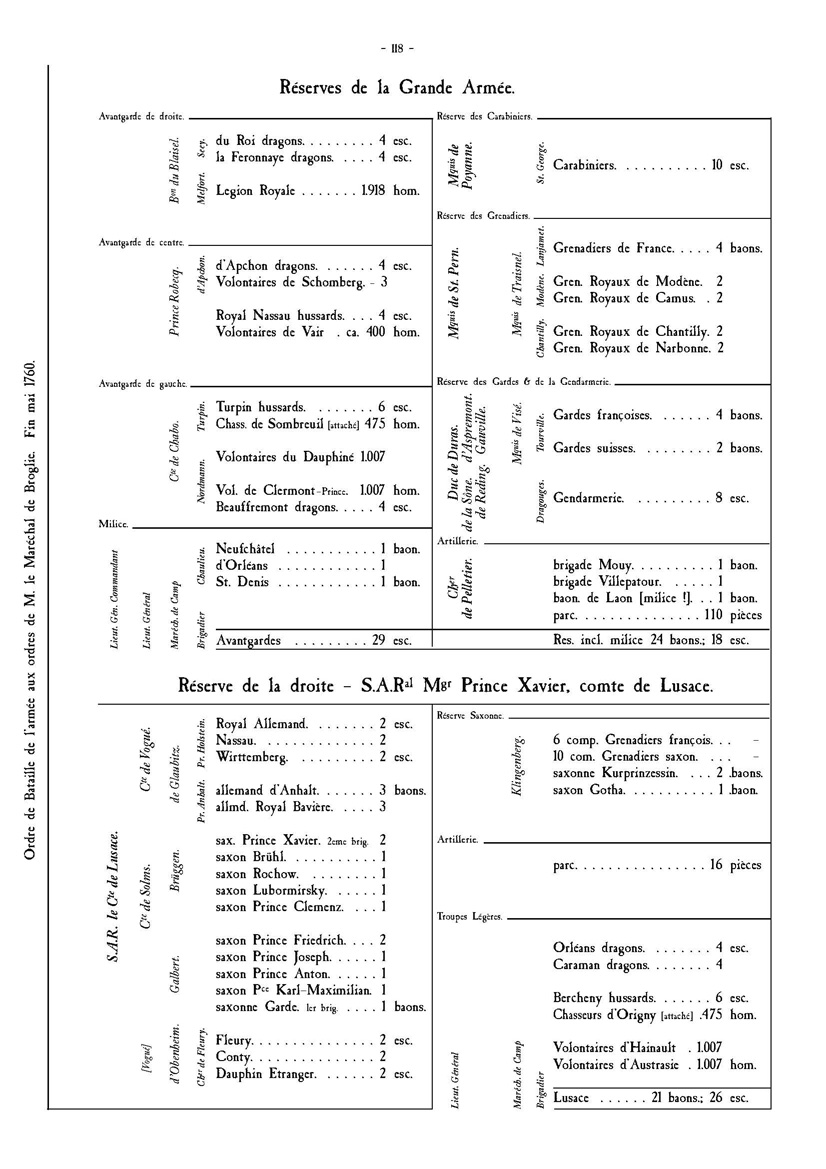
The combat of Volkmarsen isn’t based on a near – but a real historic action. All the French troops listed on my above orbat sheets were the ones that took part in the affair, really. Also the historic order of battle for the Allied corps of general Spörcken is authentic as well has the troops under Wangenheim and Oheimb deployed to support him.

The scenario is based on the same 24 July operation that also my earlier Saxenhausen battle further below is based on. What makes it so interesting to me is the rather unusual vast number of light troops committed in this battle. More then 50% of the French total Lights of the Army took part here, and also a good part of the Allies Lights were involved. I never played a SYW game with so many light troops involved. I’m curious how it will play. 


The odds in numbers in favour of the French should be somewhat offset by the nature of the terrain, with the Allies found well concealed by a number of mostly marshy banked streams or rivulets, crossable at the bridges and marked fords only.
General Chabot's command of about 7,000 light troops closing in on Spörcken's position
The Kugelsburg ruin ontop Kugelsberg hill, occupied by parts of Spörken's light troops. As I don't have the Légion Britannique, my lights are substituted by Highlanders, Jägers, and Hussards

Spörcken with his forward troops near the walled town of Volkmarsen

Spörckens camp ontop the Scheid high ground


From all I was able to collect, the real historic action was fought for the most part as a mere cannonade, with only some of the light troops actually being committed. That’s why it is found below the horizon of most of the available history accounts, I believe. And it is also the reason why it cannot be entitled a battle. Neither were the 2 armies main forces involved, nor did the action end up in a general engagement of most troops present. The newly raised Légion Britannique had its ‘baptism of fire’ that day as it engaged in a smart fight for the contest of its advanced position around the village of Külte. This part of the historic action, I have not included with my scenario. I start with the French being master of Külte and at the point to advance on Volkmarsen. The troops told to support Spörcken never did so, but were either found committed by the force of general Clozen, or the force of the grenadiers of general St.Pern with that days general attack of the entire French army. The minor changes I did to turn it into my Scenario are 1st: the supports of Wangenheim and Oheimb really being in support as off table reserves, & 2nd: as a result of it, the French force of Clozen told to prevent this will also engage. I assumed, old general de St.Pern either was found lost – as at Krefeld in 1758, or lacked the required determination to beat or at least tie his opponents – as happened with his somewhat screwed attack at Bork (Westphalia), 29 Sept. 1758. General Kielmansegg’s few troops as part of Wangenheim’s command were enough to tackle him, and the remainder managed to march off to support poor pressed Spörcken at Volkmarsen. 

The report on how the game went will follow once it has being played.

Finally, 18 June, it has been played. See the below for more details of the scenario settings and AAR.

Playing the Action of Volkmarsen
Terrain
All streams, except the Wetterbach, are marshy banked and are impassable for artillery of any kind. All line infantry crossing will loose their battalion guns. Artillery can cross at the existing bridges and the fords found at Billstein Mill, Roden, and Külte.
Between Volkmarsen and Billstein Mill, the Twiste is edged by orchards blocking line of sight and providing some cover for light infantry, but will also disorder formed troops while moving through. All other wooded areas are treated as dense, or as forests in V&B terms.
Special Scenario Rules
As can be seen on my orbit sheet, all French dragoons are treated as light cavalry, in this game based as cavalry skirmishers. In addition, they may dismount and fight as light skirmishing infantry.
All the line cavalry based on massed stands is considered heavy, regardless whether it is dragoons, horse, or cuirassiers
Engineering
As an additional scenario rule, the French principal force of Du Muy is assumed to have light bridging material marching at the head of its two columns. They receive 2 such bridges which they are allowed to jet across the Twiste Stream at a point of their choosing. Any French unit of Du Muy's Corps may simply be moved to the desired spot at the Twiste Stream, and the bridge construction will commence with the next turn at this chosen spot. It takes 3 hours/turns to complete the construction of such a bridge (here I follow the time scale of the Austrians crossing the Lohe stream at the Battle of Breslau, 22 November 1757. Under the cover of several heavy batteries they managed to throw 7 such column bridges across the Lohe in precisely 3 hours 15 minutes, and within sight of the Prussians! The Austrians took good advantage of the dense morning fog found during this time of season, while its batteries silenced all threatening Prussian guns within a matter of an hour as the weather cleared. To give the French a chance to accomplish something similar without the support of the Austrian siege artillery at hand that day, I decided to cover the Twiste Stream with orchards, extensive enough to conceal it from other but close range vision.)
Victory conditions
The French attack and move first. The game starts with the 9 a.m. turn and ends with the 9 p.m. turn, or earlier if the one or other side is found defeated before. To win, the French must seize either Volkmarsen or the Kugelsburg ruin in combination with the Watchtower on the ‘Scheid’ high grounds (with this game treated as a village). The Allies win if the French fail to archive their objective till nightfall.
Initial deployment
French
All French troops are deployed on table except the detachment of general Clozen, who will arrive only the turn after the last Allied reenforcement has entered the table (see afore sketch). With our game, all French entered in my simplified house rule cross country march column with all units found with a depth equal the unit frontage if deployed, except artillery, which is found with doubled depth of its bases depth. Du Muy enters in two columns with the lead elements already past Külte and closing in on Volkmarsen. Maréchal Broglie's younger brother's command enters in a single column with the lead elements already near Billstein Mill. Chabot's light troops may deploy formed anywhere within 10 inches/thousand yards of Wieberkirch on the East side of the Erpe Stream.
Allies
General Spörken's principal force deploys on the ‘Scheid’ high ground were it was found encamped. Its left aligning towards Lütersheim and its right stretching past the ‘Watchtower’. The light troops of the Légion Britannique may be placed anywhere along Spörken's side of the Wetterbach, Twiste, and Erpe streams. Also the Kugelsburg ruin and the woods to its north may be occupied. In addition, 1 grenadier unit of Spörken's main force may occupy Volkmarsen.
The command of general Oheimb will enter on the South edge of the table between Lütersheim and the Erpe Stream with the 1 p.m. turn, and Wangenheim with the 2 p.m. turn immediately behind Oheimb.

Well then, how did it play?
Saturday 18 June – Kolin & Warterloo Day – we finally managed to gather and play the Action of Volkmarsen. Two players on the French side, including myself, and once more M*** playing the Allies. Possibly not such a good decision with regard my continued desire to see the French victorious. M*** defended his position most brilliant and in combination with his notorious lucky dice – believed to be secretly blessed at Santiago de Compostella – he left the French without a chance.

Initially, all went fine for the French. In two columns Du Muy's Corps passed Külte and neared on Volkmarsen. The first or right column under my command, comprising the artillery and the infantry of the first line, started to form behind the Twiste to the west of Volkmarsen and with the second turn the construction of 2 bridges commenced right in front of them. 
Below see another image of one of my newly scratch build wooden bridges. This image was done at my earlier solo play-test game. For once, those Pionnier miniatures that had spent all their life in my shelf were found with a ‘real’ mission in a game.
L*** commanding the second or left column comprising Castries cavalry and the infantry of general Travers opted to cross the Twiste at the bridge near Volkmarsen.
Here, they met determined opposition. The light troops of Chabot headed for the Kugelsburg hill in an attempt to get into the rear of the enemy.

They met little opposition. M*** let them close in cold blooded by calculating his reinforcements could deal with them at a later stage of the affair.
On the French right, the command of the comte de Broglie closed in on Billstein Mill in an attempt to tie as many Allies as possible in order to prevent them to spoil the construction of the bridges. M*** concentrated most of his artillery against Broglie inflicting heavy loss to the French.

In my game, Broglie's command was represented by my Saxons under Lusace. Note my new scratch build Saxon ammunition cart on the right, that came along with the Saxon Quick Firer guns. Below see a closer take of my new French and Saxon ammunition carts. I'm rather fond of them, though, the Saxon model ended up too large. It should be smaller, now that I see it next to the others.
Broglie's command (my Saxons) were eventually fought down and exhausted before the bridges were completed. At around the same time the Allies reinforcements arrived in the rear of Spörken's force, the bridges were completed and the French infantry started to cross the Twiste. I guess I was too eager to get as many troops across that bloody stream as possible.

The result of it was a rather dense mass of disordered French assembling behind only a light screen of formed troops. Too light, as it turned out. M*** saw the moment to strike and threw in all his cavalry and more infantry at close hand to deliver a most violent and determined blow. The French first line was thrown back causing multiple routs among the disordered troops in the rear. This major accident decided the day. All of Du Muy's first line infantry was smashed in a single strike. The French continued to press forward with all that was left, but with the meanwhile engaging Allied reinforcements, Spörken had more troops then needed to see off any following French attacks. All French objectives remained in Allied hands. A clear Allied victory once more.


18 February 2016

The Istha Village Chronical: A detailed contemporary eyewitness account on the progress of the 1760 Campaign in Lower Hessen


With the below, I found it worthwile to share an extract from the German language original: Hessische Chroniken, vol. I: „Die Isthaer Chronik des Pfarrers Johann Georg Fülling. Zur Geschichte Niederhessens im siebenjährigen Kriege“ [“The Istha Chronicle of vicar Johann Georg Fülling. History of Lower Hesse during the Seven Years War”], publ. by Gerhard Bätzing, Kassel 1957. (Istha village – approx 1 mile to the south of Wolfhagen).
I started to translate Füllings chronicle of the year of 1760 to make it available also to an English reading audience. I believe the information that can be extracted from his rather detailed observations are highly interesting. He starts off with the preperations and the beginning of the campaign. The more distant the war takes place, the more of his information is based on rumor and hearsay, but the closer it comes, the more detailed it is. His community is about a days march due West from Kassel. The war arrived near his countship at July 10, with the action of Korbach and saw its culmination with the two armies passing and encamping in his village July 25-30.

Well have a read yourself, if you like. It all adds so well to my ongoing 1760 Campaign ‘near battles’ project.
 
Record of the local occurrences in 1760
Now, I will get to the chronicle of a year, which, owing to the suffered misfortunes, will remain unforgettable to this community. A year, we were to face war, and most of his terrible consequences, in which especially this community sustained a loss, I believe, we won’t get over with in years. Our misery was even more unbearable, for it took us by surprise, against all hopes, all likelihood, and expectation. We had been in the hands of the Allies. Since past years August, they had swept off the French from this country, which had partly withdrawn across the Rhine, and the Allies than kept this province occupied. The Army had been significantly increased and it was hoped, that it would keep the French away from our borders, as they had been beaten the other year. Kassel had been fortified, and work on the defences endured from winter throughout spring, at all efforts and extraordinary costs.
May
With the beginning of May a small corps commanded by general Imhoff took its camp near Kirchhain on the Ohm. The Grand Army assembled near Fritzlar. May 20, Prince Ferdinand took his headquarter in Wabern, the main camp rested from Fritzlar to Kappel, the Highlanders encamped on the ‘Uhlenborn’ heath. The English headquarter was in Fritzlar, and that of the Erbprinz in Möllrich. Many new regiments from England arrived, which approached via Paderborn and Wolfhagen. The camp rested unaltered throughout this month.
June
June 6, the Erbprinz departed with a small corps, and marched to Schlitz, where general Gilsa had been in position for some time. Finally, June 23, the whole army marched off, and took its first camp near Frielendorf and Treysa. The field bakery in Fritzlar had also advanced. June 27, we were in for the first shock, for it was said, the Army is retiring, and the bakery and baggage train had returned to Fritzlar. Shortly later, it was said the Grand Army still kept its camp near Ziegenhain, but the Erbprinz had to conduct a hasty withdrawal from Schlitz to Homberg, and general Imhoff had been forced out of his position near Marburg with heavy loss, and had now joined the Grand Army [the chronology of events has been somewhat confused here, as it was all based on hearsay]. To all those controversial news, the French apparently had captured Amöneburg and Marburg, and Prince Ferdinand now had his headquarter in Michaelsberg, and the Erbprinz headquarter was in Obergrenzbach. It augured badly, as many heavy guns and ammunition were send back to Kassel.
July
Afternoon, July 1, it was said the French were in Ippinghausen. A horrid mystery to us it was. The next day it was said, about 500 light troops had arrived at Züschen by dawn, captured eleven of general Granby’s own horses, and thereafter advanced to Fritzlar. Here, in haste, they had looted general-commissioner Massow’s baggage train, nailed a number of guns, captured some English baggage along the main road, poured out the flour of 40 flour wagons, and made off with all horses. Without doubt, they had been informed of the approach of a small corps under general Luckner. The French took the route via Züschen and Numburg, here they demanded for beer and brandy, in Ippinghausen a number of men absconded and engaged into marauding. 20 Allied hussars made after them, while Luckner took his way via Bergheim in order to cut their retreat. A detachment met the French near Freihagen, engaged in a skirmish, killing many and taking some 60 men prisoner along with a number of horses. For a while now, all was quiet. Then, Wednesday July 9, it was said the whole French Army had left its camp at Neustadt and Speckswinkel by night, and is now advancing on Korbach; while at the same time Luckners hussars and the Erbprinz corps are advancing to Sachsenhausen, followed by the Grand Army. Thursday July 10, one could hear a violent cannonade. It lasted till 2 in the afternoon. You could not only hear the guns, but also the small arms fire. So intense was the fire, that one would have believed it to be the noise of a major battle [This was the clash of the French and Allies combined Avantgardes at Korbach]. Our fears were great, and we all hoped the Allies would remain victorious. The same evening, I was informed by his most admirable provost Köhler from Wolfhagen, of the Erbprinz engaging with only some 12 regiments with about 40 thousand Frenchmen. Initially they had been beaten off, but finally he had to leave the field to the French, leaving some 7 guns, after suffering great damage from their guns. This news was confirmed the other day, and our casualties were said to be not more than 800 men. The same day as the action occurred, it was said, the Grand Army had arrived at Höringhausen, though, taking its camp without tents. The same day, a detachment of hussars occupied Wolfhagen and secured the towns gates. Both armies now opposed another; the French encamping in Korbach, and the Allies in Sachsenhausen, where Prince Ferdinand’s headquarter was set up, whereas the English’s was established at Höringshausen. Sunday July 13, general Spörcken’s corps of about 18 thousand men, that had been resting in the Münsterlands, now had arrived at Landau, Spörcken took his headquarter in Stadtberg on the Diemel [now Marsberg] the other night, after forcing out the troops of count St. Germain from this town. Now the Allies would hold the line along Volkmarsen–Stadtberg [Marsberg]–and Landau. July 15, Spörcken marched from Landau to Billingen, and on July 17, to Lutzen. On this day it was said, the French had occupied Mengeringshausen and Arolsen. July 18, it was heard the Erbprinz had ruined a French corps of about 6.000 men in a surprise attack encamped near Speckswinkel [This was the Action of Emsdorf]. 6 guns, and all of their baggage had been captured, and three generals were made prisoners, the prince of Anhalt-Köthen among them. July 20, it was heard the Erbprinz had captured 600 French oxen at Halsdorf and Luckners corps had ruined some 7,200 sacks of flour in Marburg, and captured a lot of baggage. July 21, 60 centners of hay were foraged by the Hannoveran regiment of Waldhausen in our village. July 22, English cavalry and artillery servants foraged. They receipted one forage unit of 25 rations with 10 pounds per ration. The total amount of hay that had been foraged on receipt within two days was 566 'centner' [hundredweight]. Wednesday, July 23, the foraging intensified. Countless parties kept coming in – a many of them went off without paying. The English had guarding patrols to keep their foraging parties from engaging in 'desordres'. My hay was not foraged, and I thought I was lucky. But to my sorrow, I would loose all of it within the next days by English and French billetings, without receiving a penny for it. The others could at least hope for a return sometime in the future. We would have been lucky if it was only the hay we were to loose. But, even worse, the fields abloom, of which even the old people could not recall of ever seeing such a blessing before, were to be completely ravaged within the next few days. And thats the story:
Thursday, July 24, one could hear a most dreadful cannonade on the Allies right wing near Volkmarsen. You could see all discharges of the cannons from on top the Isthaberg. At about 11 in the morning it was heard in great fear, general Spörcken’s baggage train was marching right through the Wolfhagen fields. It seemed to settle at the 'Gotzenberg', but soon later it continued its march, and eventually passed through our community. Our fears grew, as we saw the Grand Army’s baggage approaching towards us. We saw the bakery wagons carrying raw dough. We took this as a sign for the Allies retreat. A number of officiers reassured us, that the baggage train had marched off without orders and would soon after return. At 2 in the afternoon the cannonade ended, and it was said the French had captured a battery. The same day we were informed of the Allies right wing being forced into withdrawal, and the French having occupied Ehringen and Viesebeck. Fischer’s men had plundered Breuna’s bailiff Faber and vicar Coester, and patrolled as far as Nothfelden. Friday, July 25, the cannonading continued, while the passage of the baggage still endured. At 8 in the morning we learned of the English headquarter to be set up in our community. Many English soldiers were marauding poultry, hog, and raked the peoples chests, until, on my request, a German officer send a Brunswick detachment to care for our security. The right wing now rested at the Isthaberg quite near the so entitled 'Donnerschlag', and stretched towards Altenstädt. English artillery was deployed near the 'Billstein', and a number of regiments formed up on the Istha fields. The Allies ravaged the surrounding fields as much as they could. The small prayers house on our graveyard along with the benches, which had been left untouched by the French Legion Royale Anno 1758, was now torn apart and burned up. Mylord Granby had his lodging in the vicarage.
The 4th French Invasion
On Saturday, July 26, Mylord Granby called for me and informed me in French, the Army will leave at around 9 in the morning. He proposed to send my valuables to Kassel. My wagon was to join his personal convoy, and with his passport, should travel forth and back unharmed. How terrible a proposal, with regard to my present condition! I was lacking the means to arrange for all within such a short span of time. I would not get a transport, even at the price of 100 Reichsthalers cartage for the way to Kassel. All horses had been taken away by our folks and were now hidden in the surrounding woods. One can imagine my feelings. The many men’s and wagons turmoil of the departing army lasted till about 1. By this time, a column of the Arriergarde, commanded by the Erbprinz, passed this village. You could now hear the cannonading coming closer. Continuously it was asked for bread, milk and other victuals. The Highlanders were the last to pass the Lower Lane and formed up on the 'Kampe', and than headed for the Isthaberg, where they deployed within the hedges. From my upper chambers window one could observe several bodies of French closing in on the hidden Highlanders and exchanging fire. All during this time, it was dead quite in the village. All inhabitants were hiding. This silence was the more fearsome, as it was succeeded by a horrible turmoil. This silence lasted about half an hour, till one could hear the clatter of a single horse. It was a French Schomberg dragoon, and, with a pistol in his hand, crying out for me and asking for money. I gave him 1 silver Thaler. Soon he returned, accompanied by 2 more dragoons and a Fischer hussar and now they all asked for ham. My wife gave them one. Now, all got off their horses, drew sabres and entered into the house. My wife had to unlock the pantry. They took two chicken, game, along with some bread, sausage and butter. The Fischer pulled my golden watch out of my pocket and made off. After complaining to another Schomberg dragoon, he made after him. Shortly later, a whole piquet of these dragoons appeared. I addressed the officer, asking him for a 'sauvegarde', which he instantly conceded to me. He ordered one dragoon to stay with me. The officer, who happened to be the count of Custine [believed to be no other than Adam Philippe, Comte de Custine,*1740–†1793], told me of having heard of my stolen watch, and assured me that it would be returned soon. The Fischer returned the watch with the counts pistol pointed at his head. Thereafter the Fischer made off. The 'sauvegarde' kept me from suffering great harm. My house would have otherwise been completely plundered. Many hussars appeared in front of the vicarage, which he held off with great bravery. Until the quarterings would move in 2 hours later, he remained in front of the door, which I had to lock. While talking to this certain officer, I mentioned above, a single discharge was heard at the other end of the village. The whole piquet now rushed to this direction and exchanged fire with a squad of Allied hussars, of which a Brunswicker was left badly wounded. He died here. I saw him shortly before his passing away. He was the certain Mr. von Bernsdorf, a native from Waldeck. In the evening, there came two officiers of the regiment Royal Bavière. One carrying a linen sack, the other with a soldier with him, they were very polite, talked German, and told me that they had caught this marodeur in the mayors house, and that he was to be hanged the next day. They left the marodeur with my 'sauvegarde', and the mostly emptied sack to me, in order to keep it for the mayor. As they were about to make 'billets', orders came in, that Prince Robecq with his Volontaires, and a command of Swiss soldiers were to take their quarters here. Prince Robecq had his lodging in the vicarage. As he did not have his kitchen wagon with him, my wife had to cook for him. His aide-de-camp told me that I was to inform the village’s inhabitants, that they ought not give anything to the soldiers. If anybody was to be harmed, one should not hesitate informing him. Later than, as folks did inform him, he instantly went with them, and arranged for an end of their troubles. The Princes 'mâitre-d’hotel' also was a very gentile and agreeable man. In the evening, an officer asked for me, and as I got out, he embraced me like a brother. At once, I recognized him as the certain lieutenant-colonel d’Armetrout, who I mentioned on page 74 [of the manuscript – a protestant Swiss, who had been quartered in the vicars house the previous year]. The affable conduct of the French, and the fine order they kept, made us forget that we were in the hands of our enemies. Our hearts – so full of fear – in expectation of our unsure faith, had now become easier. It had been a great relieve, I had not been plundered – with exception of the victuals mentioned above. My neighbour got it worse. Vicar Lahusen from Altenhasungen, had been completely plundered, as he was hiding in the nearby woods. His loss amounted to about 500 Reichsthalers, to his own specification. Old vicar Rassmann from Balhorn, albeit staying in his house, had the same fate. He lost all of what had not been dissembled, along with 30 Reichsthalers, and suffered a wound from a bayonet thrust in his arm. The bailiff of Merxhausen had to endure violent looting, as they knocked in his door and broke his windows. Our community was speared from 'hot' looting, but more severe was the rape of livestock. Most of the communities inhabitants had spend several days hiding at the Isthaberg, with all our horses. As the Highlanders took their position on the Isthaberg, and in the event, had been attacked by the Fischer Corps, our folks were now found in real danger. They all ducked to the ground in order to escape the bullets sniping through the hedges. Soon later, the Fischer took notice of them, and not only took their money, but also forcibly depredated them of their shoes, clothes, and 40 horses, not including the many Brüdersen villages horses. Sunday, July 27, lieutenant-colonel Armetrout informed me of the Army's headquarters to be set up here. As I now told him of my many belongings, that I had hidden in the church, he asked me to carry all out, as the church was to become the location for the prisoners. Just after we took our belongings out, I had to hand over the key to the 'Grand-Provost'.
Copyright restricted image – It is published here for purely academic use without any commercial intention.
© 2014 DigAM - digitales archiv marburg / Hessisches Staatsarchiv Marburg
Maréchal Broglie arrived in the evening, while his baggage had already arrived at noon. I was left to stay in my houses parlour and chamber, where all furniture was moved. A cousin of the Duc de Broglie [his brother, the comte de Broglie?], along with a number of officiers had their lodging in my loft. My house was found so crowded that, at times you could not enter the stairway nor open the doors. The streets were found jammed with people. Outside the village a regular market stretched from the 'Pfarrbleich' farmstead into the fields. All of the fields were filled with tent rows. One Corps encamped from near the 'Hagen' all the way to the 'Läusebügel'. The main columns camp stretched from the Isthaberg across the vicarage fields, the Gehren fields, and out to the 'Hagen'. The Avantgarde encamped on the 'Rhöde' and 'Schotter' fields. The right wing aligned into the direction of Balhorn and the left wing rested near Weinigenhasungen. The French and Swiss Gardes were encamped near the 'Burgholz' and had also occupied the Burghasungen hill. Hussars were lodging in Ehlen and in Burghasungen, where Prince Robeq with his Volontaires had now been quartered. The Army remained in this position until July 30.
During the time the French headquarters was located in our community, its inhabitants sold most of its remaining draught animals at rather low price. Some sensed they would be taken away from them, anyway, others thought that by this way they would be relieved from the forced transports and could rather stay at home. But most people really sold them because they realized they would not have the means to feed them anymore, now that the entire harvest was lost. Within only 4 days our community sank into poverty. All of our fields and all the vegetables had been completely eaten up or devastated. During all this turmoil and commotion, we hardly worried about the harvest. It wasn't our most pressing concern. The want of water caused so much more misery. All fountains had been found emptied in rather short time. The soldiers and sutlers even used the horse troughs water, despite it being mostly dung. Water carriers toured the camp selling a pint for about 8 Heller [or 4 pennies]. For the Maréchals kitchen, water was brought on wagons from elsewhere. At that time I still owned 13 cattle. They suffered from severe thirst as you were allowed to enter the stalls only very early in the morning. A sentry was placed next to my hay and you had to ask for permission from the Maréchals Master of Household to take any to feed my cattle. Nevertheless, the Maréchals cooks demanded 12 measures of milk each day. My water needed for cooking had to be fetched from far distant at daybreak and needed filtering before it could be used. Our old small stove in the small chamber was now of good service to us as it became our improvised kitchen for the next days. [Content somewhat condensed] All during this time countless officiers entered the house, a many serving as the Maréchal's aide-de-camps, writing letters in my big chamber, managing the many folks requests for sauvegardes, or incidents of marauding or plundering. The Maréchal maintained a splendid dining table. Our lower chamber as well as the kitchen served as the Maréchals personal confectionary. As my house was too small for his dinner table, it was placed under a tent in Faber's garden.
The Headquarters remained here for 4 days. July 30 in the afternoon at around 2, the Maréchals baggage eventually marched off, while the Maréchal himself had already left at 8 in the morning. Major Lorch, adjutant-général to the Maréchal, arranged for my sauvegarde Friedrich Trempi, a reformed Swiss from the regiment of Gardes Suisses, who I had to pay 40 French Sous a day, apart from free board and lodge. I kept him all through November 25.
The departure of the baggage lasted the entire day. I went to my fields. Oh, what a sight! All had turned into barren land. A few days before it was a pleasure garden and such a joyful sight that you just couldn’t take your eyes off. Now, with teary in the eyes you were looking at completely devastated wasteland. You couldn’t find enough for even a single bushel of hey for our communities starving cattle. Because of the intensive patrolling, it was also no option to herd the cattle into the nearby woods undetected. Finally, I was left to sell a good number of my cattle to French butchers at half price.
July 31 was all in silence. The French headquarters had moved to Dörnberg the other day. Not a single soldier was seen. Our community prepared to untie the French camp and share out what had been left over. That evening, news spread, a many troops had arrived at Landau coming from Warburg. We had no idea what it all was about. Soon later we learned that a many wounded had arrived at Wolfhagen. The mayor’s house, all the barns, and the ‘Renthof’s’ stalls were found filled. The next morning, a number of passing Swiss stragglers told us general Du Muy’s Corps had been beaten at Warburg the other day.
… The translation is to be continued

09 February 2016

The Battle of Saxenhausen*** 24 July 1760 – again a ‘near’ historical scenario – or the story of general ‘Leonidas’ Waldgrave’s Day of Glory.

30 December our group played once more a ‘near-historical’ battle based on the 1760 Summer Campaign in the Western Theatre of the Seven Years' War. It is the third battle scenario I generated out of the historic operations of the 1760 Summer Campaign in Lower Hessen. I called it the battle of ‘Saxenhausen’ [sic.]. It was the French attack on Ferdinand’s Allied Army encamped on the high grounds around Sachsenhausen behind a Stream named Werbe. All is based on the historic situation of 24 July of which there is more original historic material to be found further below. The Allies were found heavily entrenched behind works – the fruit of finest British field engineering, I must say. I have never made much use of field works, and as a result, had little idea how ‘strong’ such a position could be. I learned my lesson that day as ‘My French Army’ suffered about its most disastrous defeat I recall in my record of wargaming.
At first, lets have a look at some images of the drama suffered by the French. That day was to be a day of Glory for the Allies.
View across the Allied army deployed in front of their camp. You see the walled town of Saxenhausen in the upper left background.
The Allies right wing moves into its defense positions. Its the division of mylord Waldgrave, with Granby's English cavalry of the right in support. 

View of Allied centre grand field work, occupied by Hannoverian artillerie. This old skratch built model of mine had been reanimated to be used in game for the very first time since using Volley & Bayonet rules. Some troops you see here are only recently purchased flats of my gaming opponent M***. His cannon seen here is really a flat model. Behind are the Hannoverian Gardes (white flag) and another of M***'s regiments, that I would now identify as the 27th Inniskilling's, really. That day, they were labeled as Hannoverians by mistake. In the lower left foreground you see his command stand representing mylord ‘Leonidas’ Waldgrave. This man decided the day. His division alone knocked out about half the French army.
View of the Allied left with my newly painted Brunswickers commanded by general Wutginau. None of them exchanged fire with the French that day, except their artillerie.
View on the centre of My doomed French. Below see a sketch of my terrain set-up as well as the Ordre de Bataille of the two opposing armies for this scenario.

The card icons seen on my army roster sheets were needed for an alternative method of turn sequence, that I borrowed from another rule set. Testwise, we dropped the alternate turn sequence of V&B but instead adopted a card driven sequence. Each division was allocated a game card, Hearts for the French and Spades for the Allies. The sequence of turns became entirely random in the event. It was real good fun, but will need more fine-tuning. I guess we had too many cards in the game. Any concerted action by neighbouring divisions became entirely impossible. It created a lot of Fog Of War.
General Rougé's 3rd centre division gives it a try and prepares to attack, only to be completely shattered about two turns later.
All the while French light troops – my Volontaires de Clermont – skirmished along the Werbe Stream on the French right while awaiting the arrival of Lusace's Corps de Reserve. They had some heavy cavalry in support – just to play it save.
Close view of the gallant Hessian hussars which was all needed to keep those Clermont Volontaires in due distance.
The English crack brigade on the far left under overall command of the Erbprinz.
Close view of the Hessian rifle armed Jagers.
View out of a Hannoverian field work. The image tells the entire story of the French progress in the centre. As soon as the brave lads crossed the Werbe Stream, they were welcomed with about the most deadly artillerie cross fire I can think of. All French were massacred within rather short.
View of a most determined line of French infantry in the centre. Soon later, they were no more.
The French now launched a violent assault on the Allies right. We see Ferdinand at the right place at the right time. You see the English heavy artillerie of capt. Macbean in the foreground defending the works.
View of the French assault of the English field work on the Allies right. The Irish really managed to knock out Macbean's heavy batterie – one of the rare successful French attacks that day. Moreoften we simply could not make an impression. The crisis on the Allied side now eveolved as St. Pern's Grenadier Reserve – by approaching along the unguarded ‘goat trail’ – attacked into the Allies undefended flank. HAH.
For a short period, the French really seemed to crush the Allies right, taking two of their works and hoisting the colours of the French king on Watchtower Hill. But not for long. In came Waldegraves violent counterstrike supported by the only now arriving reenforcements of general Kielmannsegg. No one would pass ‘Leonidas Spartan’ English division that day. Supported by a number of smart timed and well directed charges of the English cavalry, all French gains were lost within a rather short span of time. VICTORIA to the arms of Sa Majesté, le Roi d'Angleterre. P.S.: If this serries of sucesses of the Allies continues, my French Parisienne gossipers will fall short of finding proper nicknames for Homer's Allied Heros.
Now leaving the realm of fiction and turning to the true historic background
My scenario concentrated on a hypothetical clash of the two Armies principal forces supported by its immediate neighbouring forces on either flank. The situation is illustrated with the below sketch.


Historically, Broglie engaged Ferdinand’s Army at Sachsenhausen in a feint attack that day, in order to tie as many of Ferdinand’s force, while the real attack operations were directed simultaneously to Ferdinand’s flanks at Volkmarsen in the north and the Eder River between Waldeck and Fritzlar to the south. I thought, the French numerical superiority was fine enough to alter Broglie’s rather elegant plan and make him take the bull by the horns instead. Sure this was to become a bloody affair. Broglie's plan wasn't so bad – certainly much wiser then my somewhat dashy all out attack. Yeah guys… all my fault, I must confess. The official French campaign journal made the following assessment of the situation: On passait le temps aux camps de Corbach & de Saxenhausen, à s'observer réciproquement, les Ennemies avait retranché le leur, & ils ne paraît pas le devoir quitter de sitôt. D'ailleurs on n'aurait pas pu les en faire sortir de vive force sans se résoudre à perdre infiniment de monde.
While I was arranging My Scenario’s Armies and terrain set-up, I also took the effort to research the whereabouts of all other troops. 24 July was really a very busy day for the entire French army. Everybody was on the move. It was the result of some excellent staff work, I should say. I’m not aware the Austrians ever managed to launch anything at this scale without half the army being delayed or getting lost (the somewhat screwed Hochkirch and Liegnitz operations pop up in my mind here). The gentlemen from the Department of Military History of the German Great Generalstaff entitled such sort of operations as ‘Rococo Warfare In Perfection’ – but in a rather disparaging way (see vol. 12 pp. 270 ff.). They rejected the sort of operations where the light troops did all the work, while the bulk of the line remanied behind watching their progress as mere spectators with arms grounded. But, Broglie archieved his objective. A win. It was bloodshed enough. Several hundred got killed that day and a rather pressing pursuit during the next two days caused a many more casualties. Namely the comte de Broglies clash with Spörcken's Arriergarde around Viesebeck July 25 (about half way between Volkmarsen and Wolfhagen) were the roughnecks of de Vair's Volontaires got badly mauled by the mounted elements of the Legion Britannique and the sabers of the Black Carabiniers under major Monckewitz. About 800 men killed only here in a mater of a few hours on both sides.  

I decided to have a very close look at the operation in its entirety. It provides the material for even more good games.

Disposition of Ferdinand’s Allied Army
A- Prince Ferdinands' Main Force
left with 48 bats, 51 esc, artillerie
B- Corps Kielmansegg
14 bats & 6 esc, artillerie (based on 25 July figures): 9 position guns
C- Corps Wangenheim
5 bats & 4 esc, artillerie
D- Corps Oheim 

(under overall command of Wangenheim)
8 bats & 6 esc, artillerie
E- Corps Spörcken
14 bats & 18 esc, approx. 20 position guns, Légion Britannique (5 bats, 5 esc.), Hessian hussars, & Buckebourg Carabiniers noirs
F- Corps Howard & Gilsa 

(under overall command of the Erbprinz)
8 bats & 6 esc, artillerie
G- Corps prince d'Anhalt 

(under overall command of the Erbprinz)
6 bats & 4 esc, artillerie
H- Bronsvic Grenadier brigade 

(under overall command of the Erbprinz)
3 bats
J- Corps Luckner 

(under overall command of the Erbprinz)
The bulk of the Allies light troops

 
Below find the detailed breakdown for the entire Allied Army July 24 with an original record provided the Paris Archive at the Château Vincennes. The manuscript is easy enough to read, so I did not bother to do a transcription. Note the dispositions recorded here should be the situation in the afternoon 24 July. The Corps Kielmannsegg is now found encamped much closer to Ferdinands Main Force.
Also Wangenheim and Oheim are now both found encamped at Freienhagen behind Ferdinands right wing. By dawn 24 July, Kielmannsegg was located at Ober- and Nieder-Waroldern, Oheim with all the Hessian troops was in Landau, and Wangenheim with the Hannoverians was in Volkardingshausen to Kielmannseggs close support. The sheet showing the line-up of Ferdinands Sachsenhausen camp is incomplete. The generals are missing. Possibly, the author's desk got smashed by a French cannon ball leaving the poor man so shell shocked that he could not complete his work. 

Copyright restricted image – It is published here for purely academic use without any commercial intention. Source: Service Historice de l'Armée de Terre, Château de Vincennes, Paris
Disposition of Broglie’s French Army
A- Broglies' Main Force
left with 49 bats, 73 esc, artillerie
B- Corps St. Pern
brigade Grenadiers de France, plus one unknown inf. brigade (La Marck? or possibly Alsace from Du Muy's Corps), & several mixed detachments of the army.
Also encamped here around Bernsdorf and Mühlhausen but not part of Saint Pern’s force for the 24 July attack operation was la brigade des Gardes and the Grenadiers Royaux. Possibly also the cavalry brigade Royal of the Army’s left wing cavalry.
C- Corps Lusace
approx. 18 bats & 26 esc, artillerie
D- Corps Stainville
principal forces: 2 regts of dragoons (du Roy & Feronnaye), Bercheny hussars, Légion Royale
E- Corps Du Muy (formally St. Germain)
approx. 34 bats, 24 esc, artillerie
F- Corps baron de Clauzen
Inf brigade Royal-Suédois & several mixed detachments of the army, artillerie
G- Corps comte de Broglie (the Maréchal's brother)
Inf. brigades Belzunce & Swiss Castellas, cav. brigade Orléans, 2 regts of dragoons (Beuffremont & Apchon), Volontaires de Flande, & Volontaires de Vair, artillerie
H- Corps Chabot
2 regts of dragoons (Royal & Thianges), Turpin hussars incl. attached Chasseurs, Fischer Corps, Volontaires de Dauphiné & d'Austrasie, also some artillerie from Du Muy's Corps (?)
J- Corps Wurmser
Royal Nassau hussars & mixed detachement of infantry
K- Corps Caraman
2 regts of dragoons (Caraman & Orléans)
The basis for the composition of all troops remains the general Ordre de Bataille of June 1760. I have included the sheets once more further below. A number of troops had been employed guarding the French communications to Frankenberg and Margurg in the rear, or as garrison of these places. It included the regt. Boullion, the remains of the brigade d'Anhalt that had been shattered at Emsdorf, and possibly some others more. All were under the command of Stainville, but did not take part in the 24 July attack operation, to my understanding. Furthermore, the Volontaires de Clermont as well as a detachment of the Bercheny hussars along with this regiments associated Chasseurs d'Origny were operating along the Diemel River and probing into the direction of Paderborn in Westphalia at that time. 
Note: Interesting is the French use of its dragoons here. You see them exclusively employed as light troops. None served with the cavalry wings of the Army. Really, they do the same service as the hussars did with the Austrians or Prussians.