Showing posts with label My SYW gun models. Show all posts

20 July 2016

My 7YW French 8 inch Howitzer model plus my new French ammunition cart models

Finally, 3 years after presenting my research on the single French design howitzer construction of the SYW period, I managed to do my own scratch built model of the piece.
Its a heavy battery gun, not likely to see employment in a moving engagement. Its certainly not a field gun. 


At the 1:55 scale for my 30 mm flats or 1:56 for 28 mm 3D miniatures, the bore of this piece arrives at approx. 4 mm by scaling this pieces bore of 8 inch 3 lines or 8.25 inch down.
Close-up view of the barrel, which is a conversion of a model supplied by MiniFigs I purchased many yeas ago. I added sculptured dolphins and 2 rings on the chase using ‘green stuff’, based on my earlier illustration of this piece seen below.
MiniFigs did a rather good job, as their take of what should be an 8 inch howitzer is a rather dead-on-target match to the French model. I believe their template was either the French Gribeauval M 1767 or a similar English model of the same period. Anyway, the barrel is rather dead on with the earlier French construction as can be seen below with my print-out to scale.
An earlier scratch built howitzer model of mine wasn't all that bad as well. I will use this one to turn it into an Hannoverian 30-pdr howitzer, which is likewise a 8 inch class piece. The bracket cheeks will be replaced by a Danish design of this period. My gut instinct says, Hannoverian designs may have been rather similar.

There is also another interesting source illustrating a French howitzer, unfortunately incomplete.
The afore illustration along with some rather interesting information about French artillery material, actually being fielded during the SYW in Germany derives from an appendix found with the German 1766 published translation of the French original book by Le Blond, L'Artillerie Raisonnée, etc., first published Paris 1761. The appendix is the German editor's/author's add on, missing with the original French edition. The author was a certain Johann Wilhelm Jäger, Ingenieur Capitaine-Lieutenant and appointed Master of Ordnance of the Burghers Arsenal of the City of Frankfurt/Main. His illustrated barrel is a 6.5 inch piece, as per its caption. The somewhat cropped line should read 6 1/2 Zoll, to my understanding. Thats interesting. Apart from the 8 inch model, I have read only of 16 pounder models fielded in 1760. This 6.5 inch piece would be a 12 pound stone class of howitzer, rather then 16 pound stone. Possibly this isn't a French manufactured piece, but an import. Possibly purchased from Nuremberg?!?. In any case, I will try to get copies of the entire foldout sheets from the library which keeps the original book.

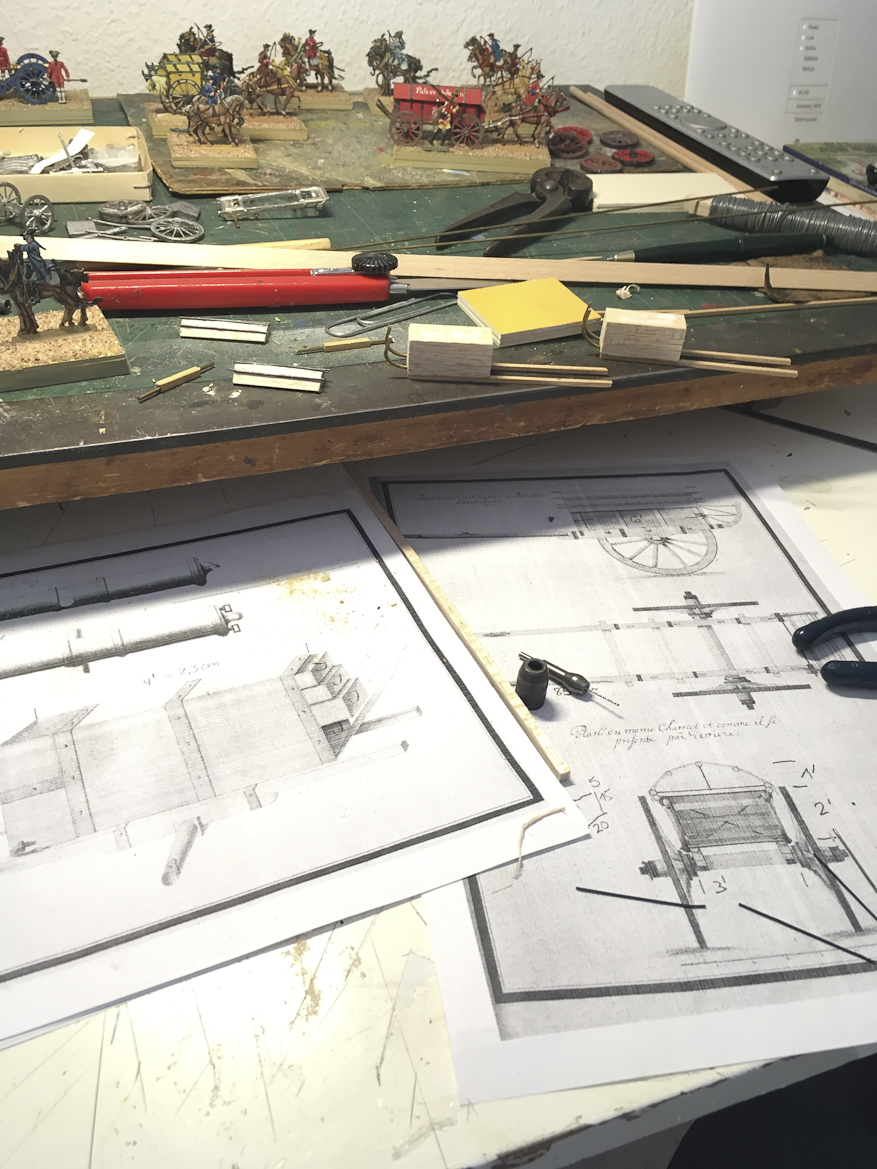
Next, I also did 4 ammunition carts for my French artillery. 

The below draft served as template for my three French carts.

Source: copyright restricted
Digital Collection
Württembergische Landesbibliothek, Stuttgart, Germany.
It is published here for purely academic use without any commercial intention.


The wonderful draft gave me the dimensions. The two models with the red coloured wax cloth covers were done according to the draft, more or less. The other with a wood construction cover I did according to the carts seen in the right background on the below oil painting. It has the drafts recommended dimensions with the ammunition container measuring 2h x 6l x 3w feet and the cover with a height of 1 foot. The two earlier ones with the wax cloth cover are slimmer with a width of only 2 feet. 3 feet lookod odd to me in the beginning, but now I believe 3 feet is just right.
There was also a 4-wheel construction found as per the below draft.
Source: copyright restricted
Digital Collection
Württembergische Landesbibliothek, Stuttgart, Germany.
It is published here for purely academic use without any commercial intention.

Also interesting is the below drawingalbeit incomplete and somewhat more scetchyit is rather similar to the above construction. It also provides a view to the way the ammunition was stored inside. This sheet is also found in the afore mentioned Jäger appendix.
Most oviously, this 4-wheel construction was used with the French ‘Swedish’ light 4-pounder battalion gun, for it also carried a share of musket rounds, stored in 50 round packages, in the centre box of the wagon. As per Jäger's caption it held 70 container boxes for an equal number of cannister rounds in the front part, and apparently the same number of boxes for shot cartiges in the rear, or a total of 140 cannon rounds, not including the ready ammunition stored in a coffre carried on the pieces limber (unfortunately undisclosed with the google library copy). This caisson entitled wagon is illustrated with a cover made of thin zinc plate instead of the former custom wax cloth, to provide better protection against fire. During an action somewhere near Cassel, Jäger explains, an Allied howitzer shell exploded near one of these caissons with the shells burning fragments setting the caisson aflame resuting in it exploding and killing a many men from among the nearby standing infantry battalion. Most apparently, this story does allude to the elsewhere documented incident at Korbach, 10 July 1760, were precisely this happended to a battalion of the regiment Auvergene. Seen from Frankfurt, Korbach is indeed ‘somewhere near’ Kassel. Therefore I would assume this sheet metal cover caissons must have first seen servive with the 1761 campaign. I think I will do 1 or 2 of these caissons as well. 
Source: image gallery of Kieler Zinnfiguren foundry at http://www.kieler-zinnfiguren.de/Listen/siebenj-Krieg.html

Above miniatures are from a wonderful series of casts of French train wagons and draught horses. I hope Kieler Zinnfiguren still sells them. I will need a whole load of them.

03 February 2016

My SYW Saxon 6-pounder Quick Firer battalion gun

I'd like to share my latest skratch built gun model to be added to my SYW Saxon corps serving alongside my French SYW troops. Eventually, I did a model of this rather eccentric Saxon 1756 fielded 6-pdr ‘Quick Firer’ battalion gun, based on my earlier research. Please see my initial article under "Saxon SYW Artillery" in my Blog. It has the entire story to it, so I won't bother to repeat it all here. I LOVE IT. Its my master piece. Let's simply have a look at the result of it all.

Here it is in ‘firing position’ with the barrel locked in this distinctive iron machine case. Next comes My Model with unlocked or released barrel in ‘loading position’.
Now, isn't that smart looking?. Below are some more shots.
With its released barrel, it really looks like some sort of ‘too early’ AA gun – possibly meant to fight those Vatican sent worrisome ‘Spy Pigeons’.
I should note that all of these guns became the booty of the Prussians with the surrender of the Saxon army at Pirna in 1756. None were fielded later on. The Saxons instead fielded the French ‘Swedish type’ 4-pounder model. But I don't care. This piece is just too special to be ignored. My Saxons in French servive will continue to field their own invented so special guns.
My model isn't entirely skratch built, really. It should be more rightly called a conversion. I used a very nice cast 28mm range model fom Foundry Miniatures. They trade it as a SYW Russian ‘medium gun’ (SYWR009).This model really makes a rather smart match.
It is very well done. Great details, and really a great model to represent much more than just Russian ordnance. I'd make it also my Hannoverian guns. Fine enough, and so much better than using Prussian or Austrian models.
I converted this Foundry model with the help of my Proxxon micro driller and some wire, nails, sheet brass, and a left over copper chain that came with an old Hinchliffe gun model I purchased back in the 1980's. Really, with my new Saxon gun model I arrive at full circle, as I have loved the dress and this self confident pose of this Saxon Cannonier I know so well from my very first book on uniforms when I was a teenager and only started collecting miniatures.
I always loved the pose of this Saxon Cannonier. The gun model is done now. Next will follow the gunners. They have already been selected, and primed. Can't wait to see them serving the piece in my next game.

23 September 2015

My SYW British Gun Models


This article, first published December 2013 has been revised by adding some more findings only recently. See below text sections in bold characters.

After doing the pretty Prussian gun models, I took the effort to add a few ‘more authentic’ dimensioned English guns to my SYW Allied Army. From among the readers of the Kronoskaf SYW-Project I was approached with the advise king George's excellently mastered cannons should deserve the same attention as my previously researched ordnance of Frederick II and Louis XV. A just advise, indeed. This article now will serve as my initial approach to the subject. Hopefully, I'll manage to publish some scale drawings in near future.
Below image shows my two selected English 12-pdr models.
Both are once more entirely scratch built. I'm not aware any foundry would provide the required pieces. Foreground right is a ‘light’ 12-pdr and left a more massive and longer barrel ‘heavy’ 12-pdr. They have been remastered from older stock and should be seen as anglicized to the best of my abilities and knowledge, rather then being authentic English in all detail. For the 1759 Minden campaign, the light model among other 6-pdrs and possibly some 5.5 inch howitzers (German 7-pdr) would have been found with the two English ‘light artillery brigades’ commanded by the captains Drummond and Foy, while the heavier piece should have been found with captain Phillips heavy English/Hanoverian reserve artillery of the right wing commanded by the Hanoverian major Haase.

Close-up view of my English 12-pdr ‘Battering Gun’. The barrel is dimensioned as per the 1753 English ordnance regulation. Its length was 7 foot 8 inch (233.6 cm or 20.9 shot). Its weight was 2632 pounds (1.192 kg) or 219:1 its nominal shot. (Source: Captain George Smith, A Universal Military Dictionary, Whitehall, London, 1779.)
Close-up view of my English ‘light’ or ‘Swedish-style’ 12-pdr Field Gun. I entitle it ‘Swedish-style’, because it belongs to a range of light 3-, 6-, and 12-pdrs which where layed with a ‘Swedish-type’ vertical iron screw-drive instead of the odd wooden wedges employed with British heavy guns.
The barrels of the light range did not have dolphins, while the heavy guns did, to my understanding. As per the 1753 regulations, its barrel measured 5 foot 1 inch (155 cm) or approx. 13.8 shot – a very short barrel, really. Its dimensions being much similar to the Prussian M1754 Dieskau design. English 12-pdr shot diameter calculated with 4.4 inch (11.17 cm), somewhat smaller then the Hanoverian or Prussian 12-pdr shot of 11.4 cm / 4.36 Zoll. Its weight was 1018 pounds (461 kg). (Source: John Muller, A Treatise of Artillery, London, edition 1768 – first published in 1757)
View of my scratch built vertical iron screw drive plugged through this carriage's single largish Swedish-type centre transom.
Some more research along with my thoughts are added with the below:
My interest focuses on the pieces being in service with His Royal Britannic Majesty's Army in Germany 1758-1762. Strangely, the sources dealing with British ordnance of this period are quite limited. The light 6-pdr battalion gun is well known, but apart from this gun, information is quite scarce. The principal contemporary work by John Muller, "A Treatise of Artillery" first published in 1757 gives a good insight to the sort of material fielded by around 1757, but seems to be incomplete and furthermore bears no information on what pieces would have been found in what quantity at any given time. He discusses the older as well as the late designs, but especially promotes his own designs to be used in the future. With its study it was found somewhat difficult to keep track and avoid the confusion of it all. 
Already by the time of the SYW, the Royal Arsenal of Woolwich must have turned into a mighty lumber storage, filled with a vast variety of ordnance dating back into the 17 hundreds.
By around 1800, Louis de Tousard in his American Artillerist's Companion, published 1809, had the following to say: "The calibers, sizes, and denominations of guns are uncommonly multiplied in the English service…. No one, except Muller, has hitherto attempted to write fully upon artillery in the English language, and if some have done it partially as the author of the Bombardier, Charles James, &c. they complain of the great difficulties they have encountered in collecting information at Woolwich. We will not attempt to raise the veil under which the operations of this academy are kept a secret, much less to decide, whether, giving information, …, or withdrawing this same information…, be a mark of science, or a deficiency of knowledge."
Now, that is not very encouraging, but we will see if we manage to close in on the models that had been selected to see service in Germany, nevertheless.

From among the vast piles of barrels found at Woolwich, we will have to focus our attention on ‘two-point-five’ classes of ordnance that would have really been fielded during the SYW. The first class would have been the range of the afore ‘light’ Field Guns. Muller's use of the rather ill term ‘Field Carriage’ for their mounting is indeed somewhat misleading, for the second class of ordnance was likewise meant to see employment in the field.
This was the range of heavier and longer barreled ‘Heavy’ or ‘Battering Cannon’ mounted on what Muller choose to entitle ‘Traveling Carriages’. They were stronger built, with longer bracket cheeks – as a result of the longer barrels mounted – and had 58 inch wheels as opposed to the 50 inch wheels for ‘Swedish-type’ Field Guns. Indeed, it has been observed, Muller's text fails to tell us what to do with the latter carriages when one stopped ‘traveling’. On a wider scope, both carriages should be entitled ‘Field Carriages’. Those, to mount the light guns should be entitled ‘Swedish-style’ carriages, because this is what they really are.
The second class of ordnance was made up of a variety of designs, hence, the ‘0-point-five’ annex with my earlier somewhat blunt classification. Each calibre would have come with barrels of different length and metal strength design. So far – so good. Muller does get us a first distance. The few bits recorded with the artillery organization of the Allied Army in Germany during the SYW will now get us some way further.

The first British contingent arriving August 1758 accounted for its complement of 12 battalion guns for its 6 battalions. None were accounted for the grenadiers, then. It was all light ‘Swedish-style’ 6-pdrs, of which is found more further below. I'll stay focused on the sort of heavy position guns that were used in Germany. Whether any heavier pieces were found with the English Corps of 1758 is unknown. The sources conflict. Some say yes. Others say all heavy guns had been entirely Hanoverian up till the battle of Bergen, April 1759. Either Ferdinand's staff records or later historians research was lousy. Possibly as many as 6 heavy guns should be accounted for. …?… Not confirmed, but it will make a far better match with the somewhat more detailed records of the 1759 campaign.
That year, more heavy guns were sent to Germany. A letter by general Sackville to Ferdinand dated London, 23 February, reveals it was ten 12-pdrs of ‘medium weight’ and four more being of a lighter construction, that had been selected. Furthermore two 6-pdrs [N.B.: long barrel or ‘heavy’ ?!?] and 6 ‘Haubitz Royaux’ of 5.5 inch calibre.
For an understanding, it is important to know the background history. Ferdinand wished to increase the number of heavy guns by 20 to 28 pieces. He favored Prussian light 12- and 24-pdrs that demanded no more then 6 horses for its draught. But Prussians couldn't spare a single piece at that time. Its foundries were already working beyond their limit, thus, Ferdinand begged for English ordnance in a letter to George II.
Ferdinand wanted to get rid of the heavy Hanoverian 12-pdr, which absorbed too much precious resource. Their draught needed 12 horses and nearly 20 men to serve them. They were of the same dimensions as the Prussian Brummers M1717, that Frederick employed with success at Leuthen, but were simply too slow moving. Sackville's selected pieces were therefore all of lighter construction. Piers Mackesy's The Coward of Minden, New York 1979, mentions capt. Phillips heavy 12-guns had a 7-horse draught, which would have been just fine for the 7'8'' piece M1753.
Another 12-pdr design, I would identify as Armstrong M1736, had a length of 6 foot 7 inches (200.6 cm) or near 18 shot. Its weight was 1512 pounds (685 kg) or 126:1 nominal shot. This would have been a lighter construction then the Prussian or Austrian 16 shot barrels which needed only 6 horses for their draught. I therefore doubt it was the Armstrong M1736 model.

[[ Correction 19 July 2014: 
As per capt. Macbean's sworn statement during Sackville's court trial, Macbean's ten 12-pdrs at the battle of Minden 1 August 1759 all had a draught of only 5 horses. He should know best, as he was in command of it all. He added this being the government allowance for this piece. I therefore assume the lighter "medium" M1736 Armstrong 6' 7'' piece being the one that was fielded at Minden in 1759, really]]
Source here: The Trial of the right honourable Lord George Sackville, at a Court-Martial held at the Horse-Guards … etc … 1760 … etc., London 1760? 

[[ 2nd Correction 23 Sept. 2015: 
With another read of the book on Sackville's court trial, I learned that witness capt. Macbean corrected his earlier sworn statement at a later session (p. 251 in afore book) stating that all of the 10 heavy 12-pounders under his command had a 7 horse draught. We are back to my initial assessment of this 12-pounder's identity. That is charming, because I'm inclined to believe, these very pieces have in fact been illustrated during their service in Flandres in the preceeding war around 1748 by David Morier. See below image.

You see the English artillery park in a scene in Flandres during 1748. The gun in the right foreground very much fits the dimensions of a 7'8'' barrel. The carriages resemble the ones John Muller describes for British "Battering Guns". Note: also the very same 'Janissaries kettle drums' with its horse trumpets was seen in Gemany in 1761 by an observer reporting to Louis IX, the Landgrave of Hesse-Darmstadt. Possibly we see here the very same pieces, that were also fielded in 1759. Not so off an assumption. The Hessian artillery of colenel Huth on the far left the same day had 4 12-pounders that also saw service in Flandres in 1748.

Detail of Morier's painting. Note the "Locker" just behind the centre transom that mounts a largish ordinady wooden wedge - or possibly two, rather then some sort of other more elaborate machinery for elevating or laying the piece. This detail may serve as a proof that it is heavy battery or ‘battering’ ordnance we see here. It should be a 12-pounder. The lockers are mentioned in John Muller's work. This one certainly did not hold any ammunition rounds, but rather served as a container for the piece's tool kit and was possibly a great sort of deposit for brandy. Also note the insignia GR II painted onto the front section of the right bracket cheek here. The gun more in the centre has "No 6" painted on its left bracket cheek. That is just the same way I added the insignia to my Allied Army's artillery carriages. I placed my GR initials on the centre section of the bracket cheek, for it is hidden behind the wheel and hardly visible with my models at the place Morier has applied them.]]

In relation to the Hanoverian heavy 12-pdr weighing approx 3310 English pounds, the English M1753 model with 2632 pounds is indeed somewhat lighter, hence, Sackville's "medium weight" classification. The light 12-pdrs would need no more then 3 or 4 horses, as it was only little heavier then the old Hanoverian 3-pdr weighing 880 English pounds and a 3-horse draught.
The two selected 6-pdr models are a dilemma. Apart from the light Swedish-type battalion gun, Muller provides only figures for the old model of around 1700 "Old Ordnance":
6-pdr: 8 foot long (244 cm or 27.5 shot), 
weighs 2128 pounds (964 kg) 354:1
12-pdr: 9 foot long (274 cm or 24.5 shot), 
weighs 3248 pounds (1471 kg) 270:1
These were of similar dimensions as the obsolete Hanoverian ordnance that Ferdinand really wanted to get rid of. I don't think the two British light brigades of the first line were equipped with just more battalion guns, especially when considering their below discussed poor performance with ranged fire.
As per the 1753 regulation, which I understand to be Muller's entitled ‘New’ pieces, the light 6-pdr barrel had a length of 4 foot 1 inch (124.4 cm) or 14 shot. Once more a very short barrel. Its weight was 506 pounds (230 kg) or near 85:1 the nominal weight of its shot. Really, the construction was lighter then the Prussian light 6-pdr of 1754. The contemporary Hanoverian author Scharnhorst mentions, the pieces shot did not carry very far. The count regent of Bückeburg, commanding the artillery of the Allied army suggested to introduce such a piece to the Hanoverian infantry in his attempt to lighten the artillery train, but was faced with the dour opposition of the Hanoverian gunners, for their 24 shot barrel 3-pdr was found to carry much further and being more accurate at the same time. Its dimensions were much the same as the Prussian M1717 3-pdr. Below see a contemporary German sourced daft of such an English light 6-pdr battalion gun headlined "Abris einer Englischen Canon mit dabey gehöriger zerlegter Mondierung" [sic.]
Source is the image archive of the Nuremberg Germanic National Museum. The sheets dating cannot be verified. The archive's caption allocates its creation to the period 1745-1755. With Muller's provided information, it should be his entitled ‘present ordnance’ which should be general John Armstrong's designed M1736 piece that is illustrated here.
According to Muller, this barrel had a length of 4.5 foot (137.6 cm) or 15 shot. The shot scale is really found illustrated with the little dots seen on the barrel. Its weight was 542 pounds (245 kg) or approx 90:1 the nominal weight of its shot. Either model would have seen service in Germany to my understanding. As said, I have no idea how many pieces were cast at what time in what quantity. A royal ordnance regulation issued at a specific year says nothing to this respect. The height of the wheels also doesn't match with Muller. He states 50 inch for the present fielded designs – i.e 1753 and later, while this drafts illustrated wheel arrives at no more then 47 or 48 inches.
My light 12-pdr comes with 55 inch wheels, really. Quite tall. See below image. I have fitted a pair of Hinchliffe 25 mm Napoleonic French wheels to my left hand model for an illustration. They make perfect 50 inch wheels with my 1:55 or 1:56 scale. Seen at this low angle, its height looks quite authentic. My instinctively selected taller wheels look better if seen from the usual exalted angle, but should be less authentic.
Below image shows my English 12-pdrs next to the Prussian light, and medium "Austrian-type" model, as well as a Hanoverian heavy 6-pdr.


27 July 2014

My SYW French Gun Models

Earlier this year, I received a a load of most pretty French gun models from Fife and Drum Miniatures. Here is a first image while busy painting and assembling the guns. 

Interspersed, you see two Hannoverian guns (red) and a Buckebourg (black) piece. All skratch-build. The marvelous French F&D models should have long be completed, but honestly, my serious ‘cannon fever’ virus has given way to a much more serious 'football fever’. I can't work anymore. 7:1 ! It nearly killed me last night.

Voilà. My earlier entirely remastered Allied Army's artillery is seen performing a Feu de Joie to cheer the arrival of the French heavy artillery in My French Armies camp. A tribute to an ancient custom among the French Gens de Guerre. The Allied Army's guns are lined up strictly according to the Ordre de Bataille found on the day of Minden. We see capt. Macbean's English medium 12-pdrs of the right wing commencing with the first discharge of joy. My receiving of these fine French gun models deserve no less then utmost Pomp and Circumstance. No less will do justice to this truly extraordinary event. 
Now, with many being assembled and painted, I must say they are among the most pretty models I have ever seen. Even better, they are authentic looking. After wargaming with French 7YW armies for about 30 years now, it was high time. My old funny painted and funny scaled models seen in the upper left now having been removed from the field inventory. The credit goes to Jim Purky, who took the effort and risks to release an entire range with Fife & Drum Miniatures. Mr. le Maréchal de Broglie has only recently awarded him the royal privilege promoting him Chief Prime Contractor of Les Armées du Roi en Allemagne. Mr. le Maréchal can't await to receive more even heavier guns. Now, lets have a closer look at the material received.
Above see the long 4-pounder field gun. The track width of the original model is rather generous. For the AWI period it may be just fine, but I reduced it somewhat, in order to make it a better match with all my existing gun models. I also took the effort of adding a pair of hooks at the front face of the carriage. I've done this with all of my scratch build models, so that wasn't much of an effort. In the background you see the Austrian 6-pdr field gun with its barrel so much shorter then that of the Vallière long 4-pdr. It really was a much bigger gun despite having a smaller calibre. The dimensions are perfect. Next comes the French short 4-pdr à la Suédoise, the French battalion gun seen in the foreground.

It looks wonderful and has just the right authentic dimensions. The ammunition box of the French battalion gun is really the Gribeauval M1765 version. Again fine for the AWI, but should be also just fine for the 7YW period. I placed the gun next to a scratch built Hannoverian principal 3-pdr model (red) and the French long 4-pounder. These three models alone should have accounted for about 60% or upwards of all cannons fielded with the campaigns of the French vs Allied Armies of the 7YW.
Next comes the Vallière M1732 12-pounder model.
Again a most authentic looking piece. It is especially nice to see my suggestion of the extra rococo-style iron fittings being accounted for.

Unfortunately, this 12-pounder as well as the 8-pounder Vallière cannon models were done to a smaller scale then the two 4-pdr models.
Something went wrong here, but that isn't of no big issue. Effectively, the F&D 12-pdr model arrives at the dimensions of the 8-pdr, while the latter model is effectively another 4-pounder.
See the French piece arrayed between a Hesse-Cassel battery gun 12-pdr (front) and a Hannoverian 6-pdr heavy field gun (back).
The French 12-pdr should really be a tad longer then the Hessian piece. Both were of similar dimensions. It matches so much better with its equivalent Hannoverian 6-pdr, a heavy field gun not to be confused with the British or Prussian light 6-pdr battalion guns. It had a barrel length of approx 246 cm, while the French 8-pdr arrived at 264 cm, both excluding the cast on cascabel and button at the rear of the barrel. As a result, I added this F&D Miniatures 12-pdr as an 8-pdr into my park of French artillery – and awaiting heavier pieces yet to arrive in the camp of the French Army in Germany.

20 November 2013

My SYW gun models – Reviewing new Black Hussar and Fife&Drum Miniatures gun models

My Artillery Research is taking a Holiday Season Break for a while. I thought of returning to my core business – that is painting miniatures.

I received the first sample gun models by US based Fife & Drum Miniatures (FDM), as well as from Berlin based Black Hussar Miniatures (BHM). 
This got me rather excited and I thought of sharing my first closer look at the fruit of all my earlier research – for all these new range models claim to be sculptured based on my drafts.
Below are the three Prussian beauties, we'll now have a closer look at. All are 28 mm or 1:56 scale.
Left is the Prussian Holtzmann M1740 3-pdr by FDM, centre is the much longer barrel Beauvryé M1746 3-pdr by BHM, and right we have the Dieskau M1754 light 6-pdr by FDM. BHM also sent me their set of 5 Cannoniers along with the limber. You see the Cannoniers dressed in grey primer. The limber, I haven't painted so far. You'll see it on the first image upper left background. The Cannoniers are fantastic in detail. You cannot get a Prussian gun crew more authentic then this one. Gunner No.1 with the rammer of course works with battalion guns only. His gorgeous crocked rammer was used for the light pieces only.
Now, back to the hardware and talking pure cannon issues: All have done a wonderful job. The models are dead on scale, niclely sculptured in detail, and should be about the most authentic Prussian SYW models money can buy.
The two 3-pdrs at somewhat close view. The wheels of the BHM piece could be 2 mm or so taller to my taste, while those of the FDM could be a tad less massy. The FDM pieces are also missing the trail rings. Possibly for production matters. I added my own scratch made ones to the FDM models. The track width of the FDM 6-pdr is clearly too generous. The barrel of the BHM piece is the most pretty sculptured barrel I have ever seen. Very detailed, and all very accurately done. But, honestly, comparing the two we are comparing Ferrari's with Maserati's.


The BHM 3-pdr barrel in close-up view. I was told, late 3D printer technology was employed for the accurate end-product.


Close-up of the FDM 6-pdr. Very nicely done. The muzzle swell is greater then it should be, but it does no harm to its visual presence. This way, the barrel's silhouette won't fail to look Prussian by its first glance if seen from some distance.

And while I was at it, I also assembled & painted a Prussian 12-pdr from Austrian based Diez foundry. Its supposed to be a medium M1758 ‘Austrian-type’ piece, as the barrel has the same length as this foundries ‘real’ Austrian 12-pdr (seen laying in the foreground). 

Some minor corrections had to be done here. I removed the trail rings, which did not come with this heavy position gun. Also the two Centre and Base Transoms are placed too low. 


I had to add another wedge serving as base to its  Richtmaschine. The carriage really is M1761 or 1766. A very similar forerunner may have been introduced in 1759 and may have been the carriage to the M1759 ‘Austrian-type’ 12-pdr. This model, though, had a barrel which was about a muzzle length longer.
Here is another piece I just finished. Foundry is unknown. 
Originally, it seems to be a battery culverine for the period 1600-1700, but it makes a perfect heavy 6-pdr with a barrel 27 calibres long. The barrel could be a tad slimmer, but its length is near on scale. A mm less would be dead on. Fine enough. I made it a Hannoverian piece, as they fielded such long barrel 6-pdrs in great numbers. For a Hannoverian 12-pdr the barrel would be too short, as well as the wheels would have to be taller. It makes a nice heavy field gun 6-pdr. I also labeled it with the makings of King George II on the bracket cheeks. I know all of the ammo-wagons bore the crowned GR initials, so I would believe, the gun carriages had them as well.
Another view of all five pieces being discussed.

03 October 2009

Russian Artillery

Here are 4 pieces of Russian ordnance. Foreground right is a "Unicorn" howitzer. Propably the most famous of Russian guns during the 7YW. Scale for all seems to be a bit larger then for 30 mm. I purchased them at this years Kulmbach/Germany convention in August. No idea what foundry they are, but they are very well done casts. Distributer is a certain A. Fingrut, a Russian located in Pforzheim/Germany. Foreground left is an early 7YW 3-pdr regimental cannon with it's distinctive 2 Cohorn type 6-pdr mortars fixed to it's "fork-carriage" that does not require a limber. It had a 2-horse draught. Background left is a 12-pdr cannon and right is to be a heavy half pud Russian scale howitzer which would approx. resemble a German 16-pdr or French/English 8 inch class howitzer . The barrel, though, is a spare piece from an English foundry, but should do o.k. In the rear of the image, I have placed an Austrian 6-pdr "Falcon" of the innovative 1753 Feuerstein ordnance with 2 cannoniers to get a feel for the scales.

The Russian 3 pound regimental piece in close up view.


Close up view of the ‘Unicorn', which I take to be the 8-pdr piece. The carriage seems to be somewhat oversized, though. Wheels are o.k.