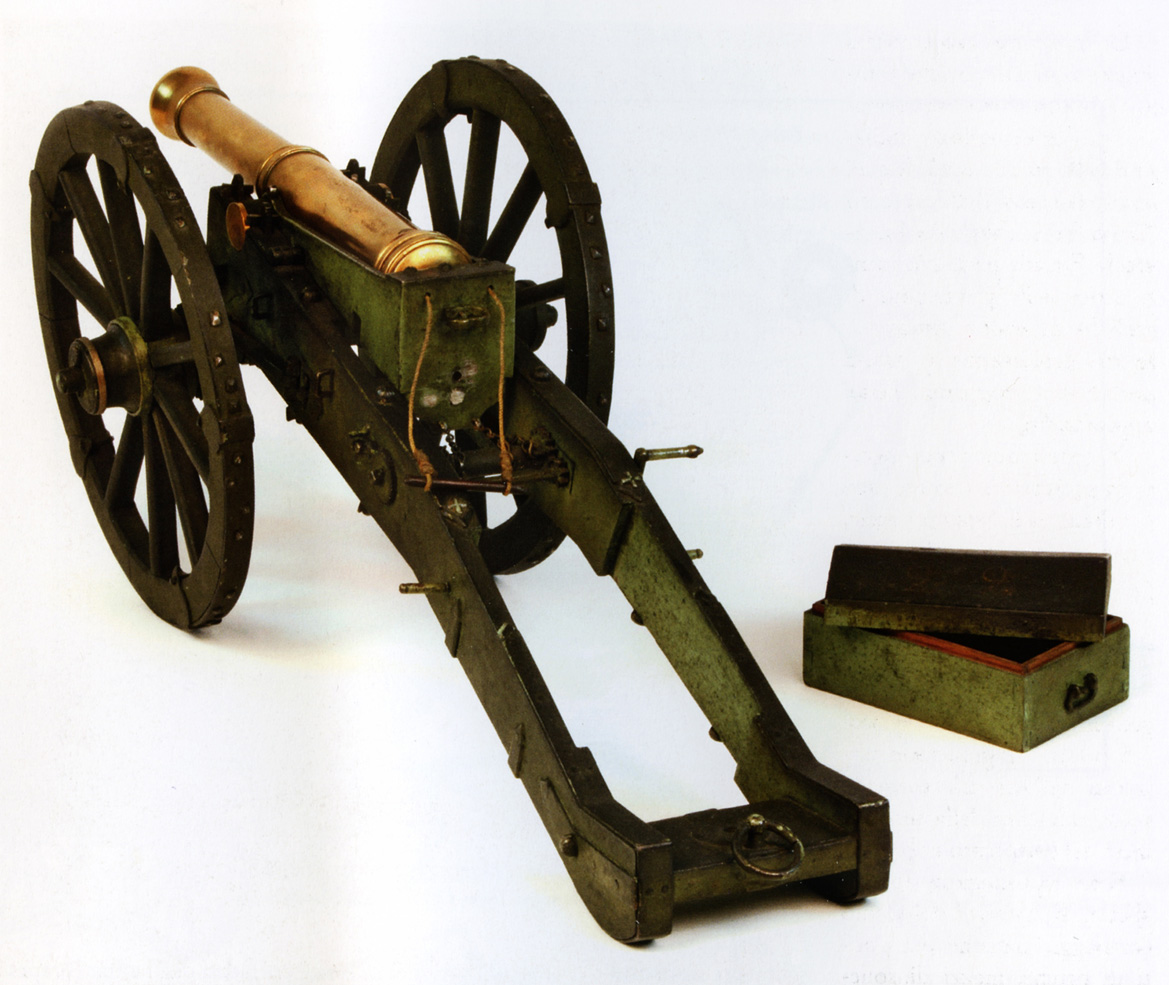
I finally managed to get started with the Prussian ordnance fielded during the Seven Years' War. It is a most interesting subject to me, for there is so little image material found with the commercially available books on the Prussian army. Even with rare ones, long out of print.
I'm so fond with the first results, that I thought of sharing it in advance.
The below first illustration, therefore, is a sort of sneak preview, as I worked off-scale my regular sheet format. More details are to follow with my next completed sheet.
More information on Prussian artillery will soon be available in English language published in the Smoothbore Ordnance Journal by Digby Smith and Stephen Summerfield. Digby Smith has also done a wonderful translation of a rare paper by Hans Bleckwenn focusing on Prussian 7YW artillery.
At this point I wish to thank all who have supplied me with this wealth of material. I have received great support from many countries ranging from the US, UK, Denmark, Italy, France, and Germany. I have also received the official permission of the Stockholm Army Museum to use their image material.
My initial decision, to do this project in English language rather then in German turned out to be a good one. The audience grows so much larger.
My special thanks to David Morfitt ("Not by Appointment" Blog at nba-sywtemplates.blogspot.de ), who has contributed the nice illustrations of the Prussian barrels and carriages insignia.
Regarding the 'source situation’ on Prussian artillery which enables me to reconstruct the 7YW period pieces, I will draw most heavily on the single most valuable 4 volume work by Malinowsky & Bonin, Geschichte der brandenburg–preussischen Artillerie, vol. II, Berlin 1841. It provides most detailed descriptions on the evolution on barrel and carriage design, but comes without images. Regarding images, most authors work with the same four of five illustrations again and again, which implies not much has survived WWII. The former Berlin Zeughaus Museum owed a large collection of scale models of which but few pieces survived. Also the Potsdam Heeresarchiv had loads of scale drafts of about all pieces ever fielded or designed in Prussia. All was lost with a devasting air raid April 1945, it seems. Some scale drawings did survive in Germany or other collections, such as Denmark. Most are post 7YW, but are of good help nevertheless.
To make matters worse, some glaring errors are found with correctly identifying some of the images. None of the more recent Historians such as Dr. Hans Bleckwenn, Die fridrizianischen Uniformen, Osnabrück 1987; or Martin Guddat, Kanoniere Bombardiere, Pontoniere, Herford 1992 seem to have noticed. The flaws start with the 1911 published little booklet by Gohlke, Geschichte der gesamten Feuerwaffen bis 1850. Gohlke comes with 3 sample images of Prussian guns. Two of the three have false captions. Bleckwenn, at least, was more cautious with presenting his 12-pounder illustration "claimed" to be mounted on a M1762 carriage. Martin Guddat less so. He presents several images of a 12-pounder scale model, a black and white photo of another 12-pounder unlimbered and a 24-pounder limbered, and fails to notice that it is all different photographs of the same piece. It's a scale model of the "Austrian-type" 12-pounder designed by Dieskau in 1759, 18 shots long, and mounted on a M1774 carriage. Bleckwenn illustrated the piece in his book. The barrel design is equally the model for the casts of 1774 or later. The carriage is of similar design as with the heavy 12-pounder nicknamed "Growler" (German: Brummer) on display at the Paris Musée de l'Armée to the present day. A barrel 22 shots long and first cast in 1761. The famous "Growlers" first fielded at Leuthen in 1757 were heavy fortress or siege guns with 24 or 26 shots barrels, not the model on display in Paris. It's dimensions was rather close to the French Vallière 12-pounder found in my January 2012 post.
16 June 2012
17 May 2012
7YW Artillery – part 5 – SAXE-POLAND
With the below, I will introduce another rare
mid-18th century cannon of which–to my knowledge–very little
information so far has ever been published, not to mention anyone has published
an image of its general design and dimensions.
Original Saxon source could not be found,
unfortunately. Instead, a set of original scale drawings can be found at the
Torino / Italy Museo Storico Nazionale di
Artiglieria illustrating a piece called ‘Canone
alla Sassone’. The museum also has a scale model. All is dated approx. 1755.
An original Sardinian–Piemontese 1757 cast 3–pounder barrel with near similar
dimensions as my illustrated Saxon 3–pounder barrel is on display at the Vienna
Heeresgeschichtliches Museum (HGM).
The museum labels it as a 4-pounder. Its caliber is 77 mm. Shot diameter should
have been approx. 72 mm, which clearly makes it a 3-pounder to my
understanding. The barrel has a length of 1,44 m. This barrels mouldings in
particular the muzzle design matches those of the scale model at the Torino
museum but doesn’t match those of the scale drawings. Also the scale drawings
carriage bears some deviations to the design of the model. I believe those
scale drawings to be a copy of the original Saxon piece that served as master
for the Piemontese pieces fielded till 1796.
![]() |
| Original scale drawing to be found with the collection of the Torino Museo Storico Nazionale di Artiglieria, Italy |
Next to this, there exists also an illustration
of a Prussian prototype 3-pounder cast and assembled with its carriage in
Berlin 1746 by the Saxon-Polish major Oettner (found in Gohlke, Geschichte der gesamten Feuerwaffen bis
1850, Leipzig 1911). The piece was tested but failed to attract the kings’
interest. Its illustrated barrel looks near similar to the Torino drawings. It
also comes with the general Obmaus designed ‘Richt-
und Lademaschine’ [Engl: ‘pointing & loading machine’]. Franz Karl Obmaus – elsewhere also Obenaus – was a Saxon-Polish lieutenant
general †1735.
From other mostly scattered German language notice
we know the Saxon M1744 3- and 6-pounder pieces were designed 20 shots or
calibers long, had a conic chambered bore, and a weight of 380 and 530 pounds
(180 and 250 kg), which makes them rather light. The barrel length/weight ratio
implies they must have been proportioned with reduced metal strength. This
detail makes a very good match to the Torino museum scale drawings which present
a 20 calibers barrel with a conic chambered bore and 3/4 solid metal strength barrel walls (18/24 descending to
7/24 partes at the front of the
muzzle). This makes for its rather slim silhouette compared to the much
shorter, but heavier Austrian 6-pounder M1753 weighing up to 800 Vienna pounds
(414-440 kg).
![]() |
| Barrel design of the original scale drawing found with the collection of the Torino Museo Storico Nazionale di Artiglieria, Italy |
This Saxon cannon belongs to the class of the so
entitled Einfallendes Geschütz [Engl.
lit. ‘dropping cannon’]. This entitlement derives from this guns alternate
method of loading, as well as laying it anew. For loading the piece when
engaged in quick-firing canister, the gunner would place the ready cartridge round
into the muzzle, and with the special design of the Obmaus ‘pointing &
loading machine’ replacing the wedges and centre transoms of the carriage, the
barrel would be unlocked from its horizontal position and drop down rearwards till
it was stopped dead by the axletree. With the illustrated carriage design
approx 65° position. The round would now place itself automatically without the
need to employ a rammer. Thereafter the barrel was pulled upwards and latched
into its previous horizontal position by means of a T-handle with a rope fixed
at the barrel’s rear and the gun was ready for the next discharge.
![]() |
| Scale model of the Cannone alla Sassone fielded by the Piedmontese army found with the collection of the Torino Museo Storico Nazionale di Artiglieria, Italy |
Prussian sourced notice tells us the guns could
fire at a rate matching ‘the rang of the church bell’ (see Gohlke, Geschichte der gesamten Feuerwaffen bis
1850, Leipzig 1911). However, the idea behind it was more for safety
concerns rather then a further increase of the rate of fire. The term Geschwindstück [lit. ‘quick-fire piece’]
alludes to a bataillon gun and its employment for quick or rapid canister fire
under close range fire conditions first introduced by the Swedes sometime
between 1700 and 1710, to my understanding. Conventional methods of loading bore the lethal risk of
the new round accidently going off while ramming the charge down the barrel.
For this reason, the crooked rammer was introduced which allowed the cannonier
to ram home the cartridge while placed outside the firing line. In case the
round did go off he would now only forfeit his rammer rather than his life.
Apparently, this sort of unintended ignition happened all too often, which must
have made some unknown Saxon philanthropist invent the concept of the ‘dropping
barrel’ for loading.
The design is indeed said to be a Saxon
invention. The date of first introduction could not be ascertained. By 1728
light 2-pounders were fielded. This we know because in that year king Augustus
the Strong made a pair of these guns a present to the king of Prussia. It was
the forerunner of the 1734 introduced 3-pounders fielded with the Obmaus
machinery. The M1734 pieces had barrels with a length of 21 calibers or shot
diameters. From a Prussian sourced paper on ammunition transport we also know
the Saxon Geschwindstücke were drawn
with limbers containing an ammunition box (German: Kastenprotze – see Archiv für
die Officiere der Königlich Preußischen Artillerie und dem Ingenieur-Korps, vol.
11, Berlin 1840). It must have been among the first pieces with this new
concept of ammunition transport.
![]() |
| Original Piedmontese barrel on display at the Vienna Heeresgeschichtliches Museum. Cast by the famous founder G.B. Gabone in Torino 1757. |
The Saxon ‘Quick-Firers’ first test in battle
seems to have been a rearguard action known as the Combat of Radojovaz, Serbia,
28 Sept. 1737. The relation of the army’s commanding Feldmarschall Khevenhüller notes it was the Saxon Geschindstücke in particular, that decided the action for the
Imperials because of their sustained rapid [canister]-fire which had such devastate
effect against the densely packed Ottoman hordes attacking and bent on capturing
the Imperial army’s grand baggage (found in Streufflers
Oesterreichische militätische Zeitschrift, vol. III, Vienna 1828, p. 347.)
The same pieces were also fielded during the First Silesian War with the
campaigns of 1741 and 1742. In 1744 new pieces were introduced with only 20
shots length. Now also a 6-pounder Geschindstück
was designed. This is the piece I have reconstructed with my above
illustrations. As the Prussian records of captured pieces imply, 3-pounders only
were fielded in the battles of Hohenfriedberg, (4 June 1745), and Soor (30 Sept. 1745). With the battle of Kesseldorf (15 Dec.
1745) also the 6-pounders were fielded. With this battle the Prussians had a
taste of their performance. A good number of 6-pounders along with heavy
battery guns were deployed around the village of Kesseldorf, the objective of
the Prussian right wing attack. The initial attack was repulsed because of the
defenders murderous canister fire, it is noted. It was the mindless
counter-attack of the defending Saxon grenadiers that gave the Prussians a
chance for a second try. Also the attack of the Prussian left onto the Saxon
held high grounds nearly ended in defeat once more because of the very deadly
Saxon artillery fire.
By 1756, a total of 50 6-pounders were found with
the Saxon army in its entrenched camp of Pirna. All fell into Prussian hands
with the Saxon surrender. A total of 46 was found undamaged and these pieces
were issued to the Saxon infantry regiments that were now incorporated into the
Prussian army. It seems, too many of the original Saxon cannoniers preferred to
leave Prussian service to enlist with the newly formed Saxon army in Hungary so
that by the start of the 1757 campaign no gunners were found that knew how to serve the
Quick-Firers. From Prussian source we know these pieces never took to the
field, the former Saxon bataillons were equipped with Prussian 3-pounders
instead.
To complete this article, I guess, one more word should be added to answer the question, likely to be raised - why did this apparently innovative and effective weapon not find wider introduction?
We know, this type of cannon was fielded only by Saxony and the Kingdom of Sardinia-Piemonte for any longer period. Also the Spanish National Archives have a scale drawing, dated 1760, illustrating a carriage of a much similar piece. As per its descriptions it was fielded by the Neapolitan army then. The entire construction was certainly more costly then a cannon fielded with the ordinary design. This may have been the reason why the large military powers of Europe rejected it. The fact that it was introduced in Saxony and Piemonte, two of Europes' most affluent countries, and both with only a smallish army would support this suggestion. In technical terms, it was said the machinery had the disadvantage that any light damage to the machinery suffered in action would disable the piece.
09 April 2012
7YW Artillery – part 4 – HESSE-CASSEL
I decided
to turn my research to a Seven Years War army that played a major part in the
conflict, but, as yet, has received but little attention to the artillery it fielded.
For that reason, I believe, the below presented piece will be a ‘first-time’ ground
breaking introduction, for I’m not aware anyone has made an attempt before to
reconstruct or present an image of Hessian ordnance of this period. This is why
I felt the need to expand somewhat more on what made me do what I did. The
below will, thus, be somewhat more extensive.
My
illustration of a Hesse-Kassel 3-pounder regimental cannon is for the most part
based on the wonderful material provided with the digitalized exhibition of the
Kassel Wilhelmshöher ‘Kriegskarten’ (‘war
maps’) available from the Hessisches Staatsarchiv
Marburg, Germany (DigAM) at www.digam.net/?str=177
It provides
several drafts of barrels and carriages of around 1770 as per the Marburg
archivist’s dating. Unfortunately, it has but few documents of the earlier
period of between 1740-1763.
Of
particular interest is document WHK 43/14 (folder 43, doc. 14). It’s
explications are headed Affuitirung nach Schwedischer
Manir wonach die Hessische eingerichtet ist,… [sic.] (Engl.: Carriage
construction in Swedish manner as to which the Hessian is equipped…)
![]() |
| document WHK 43/14 (folder 43, doc. 14) |
I decided
to take this reference to Swedish carriage construction rather serious and
point my research into this direction. One should be aware that earlier in the
18th century, Landgrave Friedrich I. of Hesse was also King of
Sweden, reigning from 1720 to his death in 1751. It is therefore rather
compelling to assume, some of the Swedish artillery know-how made it’s way to
Cassel during this period.
We know the
Hessian artillery was turned from its ancient semi-military guild footing to a
regular militarized establishment only in 1741 with the raising of a so
entitled standing Artillerie Corps. New
pieces of a lightened design were introduced. In 1741 twelve light 3-pounders
to serve as regimental pieces for the infantry battalions, along with some
6-pounders as a complement of heavy battery pieces were cast at the Cassel
foundry. Some more 3-pounders would have been cast during the next yeas in
order to supply the later raised regiments with cannons, replace losses, and to
arrive at the regulation 2 pieces per bataillon by 1757. During the War of
Austrian Succession (1741-1748) also a battery of 4 Hessian heavy 12-pounders
was fielded (see: Rudolf Witzel, Hessen
Kassels Regimenter in der Alliierten Armee 1762, Norderstedt 2007).
I’m near
certain these M1741 pieces were likewise fielded with carriages adapted in
Swedish manner and those drafts of the M1770 pieces illustrate material not so
different from the earlier design. Really, for the period well after the 7YW,
proportioning a barrel based on it’s caliber – i.e. diameter of the bore, instead
of the shot diameter, and also specifying the dimensions of the carriage likewise
by multiples of the caliber must be regarded as ‘old school’ and far from
latest state of art in gunnery by 1770. A good number of details seen with these
Hessian drafts can be found with Swedish scale drawings dating to the 1720’s.
Above image
shows a contemporary draft of the Swedish 3-pounder Regementsstycke M1725 (source: Jakobsson, Th., Artilleriet under Karl XII:s-tiden, Armémusei
Skrifter I, Stockholm 1943). Aside
from this pieces unusual rounded trail, the Hessian draft (WHK 43/14) is very
close to this earlier Swedish design. Of special concern are those distinctive ‘lids’
that serve to fasten the barrel to the carriage, which so far, I haven’t seen
with any other nations artillery of this period.
The Swedish
barrel of the M1725 3-pounder was 18 calibers long. The Hessian 1741 cast
3-pounders may have been also 18 caliber barrels instead of the 20 calibers with the M1770 piece. We don’t
know.
Also the
way the straps around the wheel fellows are arranged is rather distinctive
Swedish as much as it became distinctive Hessian likewise as the DigAM
collection of scale drawings reveals.
![]() |
| Swedish gun carriage of 1698. (Source: Online archive of Stockholm Army Museum, Sweden) |
Also of
interest is the Swedish machinery driving the elevating screw, a design that
comes in a wooden case, which is placed on the pointing transom. It looks much
like grandmas’ old coffee mill. We know colonel Dide zu Fürstenstein introduced an elevating screw for the
regimental cannons in 1742. The DigAM collection is missing any hint to its
design, but as the centre transom of the Hessian piece is placed between the
bracket cheeks the very same way as the with Swedish M1725 piece, we should
assume the Hessian design wasn’t much different to the Swedish one. The
distance between barrel and transom is too large for a horizontally placed
screw driven wedge, employed by Prussians and Austrians for example. It must
have been of a vertical design.
![]() |
| Source: Online archive of Stockholm Army Museum, Sweden |
Here is an
image of the real Swedish M1725 piece. Note the iron gears that serve to
manhandle the piece in action. The Austrians introduced a much similar design
in 1753 with their 3 and 6-pounder filed guns, along with the 7-pounder light
howitzer. There is no indication that Hessian bataillon guns also had them. I
believe the Hessian pieces were moved with ropes only. The above Swedish gears
were designed to manhandle the piece the way illustrated below.
![]() |
| Source: Jakobsson, Th., Artilleriet under Karl XII:s-tiden, Armémusei Skrifter I, Stockholm 1943 |
Finally,
some more words on the distinctive Hesse–Cassel colour furnish for its
carriages. No word could be found with the sources available to me. I’m left
with this single, albeit, reliable source: an oil painting attributed to Johann
Heinrich Tischbein senior, in 1753 appointed court painter to Landgrave Wilhelm
VIII. (1753-1760). It is titled the ‘Princes painting’ showing Wilhelms’
grandsons.
To the left
we see Wilhelm (later IX), dressed in the officers’ uniform of his regiment
Prinz Wilhelm Cuirassiers (K1). The Kassel museum does not date it, but the
inducement for this painting was most certainly Wilhelms’ declaration as
aspirant of the throne of Hesse Hanau, in 1754. Normally, the son of the
reigning landgrave would receive the countship of Hanau, but Wilhelm VIII. son
Friedrich had converted from Calvinist to Catholic religion sometime before.
The Hanau Estates therefore refused to accept him as their sovereign. For that
reason, his son Wilhelm was to become count of Hanau instead. The settling of
affairs took a number of years. Wilhelm became count of Hanau only in 1760, it
seems. The painting, nevertheless, should be dated earlier or around 1754.
Of
particular interest is the collection of arms on the right fore and background.
The pair of cavalry standards along with the kettle drums of K1 can be
identified and have been regarded as authentic elsewhere before. The pair of
infantry flags can be identified as those of the Hesse-Hanau Landregiment (IR
13 in 1763). Note the colouring of the mortar, and also note the pair of
bataillon guns seen in the right background. I would identify them as the guns
of the Hessian Garde Regiment (IR1), for Wilhelms’ two younger brothers are
dressed in the officers’ uniform of this regiment. The painting was certainly
done at Cassel and the arms would come from the Cassel arsenal rather than that
of Hanau, with exception of the flags, whish should have been the new ones,
bearing the arms of Wilhelm.
A close up
view of the background cannons reveals both are likewise white with the wooden
elements and the metal parts are furnished red. Also the spokes can be seen
painted red. I decided to base my illustration of the details found with this
oil painting. Red and white are the principal Hesse-Cassel colours. Painting
the guns according to the arms colours wasn’t uncommon at all. Examples would
include the early 18th century Prussian white wood / black metal,
Austrian yellow wood / black metal, and Saxony vice versa – to name only a few.
18 March 2012
7YW Artillery – part 3 – FRANCE
I will try to give some insights as to what pieces were generally fielded in what quantities during the Seven Years War.
At the beginning of the 18th C., French military authors advised a ratio of 1 piece per 1.000 combatants. This ratio seemed to have remained rather consistent – more or less – till well into the Seven Years War. Only the introduction of the Swedish-style light 4-pdr bataillon guns as per the Royal Ordonnance of January 1757 increased the ratio of gun per combatants somewhat.![]() |
Detail from a series of paintings with scenes
of the War of Austrian Succession by Nicolas van Blaremberghe
painted between 1778 and 1790.
The field artillery of the 1748 royal French army of Flandres consisted of 14 16-pounders, 16 12-pdrs., 30 8-pdrs., 80 ’long’ 4-pdrs, and a reserve of 10 Swedish-style short 4-pdrs. (at that time not employed as bataillon guns) – or a total of 150 pieces for an army of approx. 114.000 men (See: Ernest Picard, L'Artillerie Française au XIIIe Siècle, Paris & Nancy, 1906; also Guillaume Le Blond, L‘Artillerie Raisonnée, Paris 1761).
The French army of the Weser in 1757 under maréchal d'Estrées' fielded some 100 pieces for approx. 100.000 men, not including the bataillon guns. A more detailed break down could not be found. However, the marquis de Valfons, chief of staff to general Chevert, gives a record of the heavy artillerie brought into action by general de Vallière on the heights of Hastenbeck a day before the battle as the French army was filing into its position. He notes Vallière managed to deploy 30 pieces of 16 and 12-pounders as well as 4 24-pounders for the bombardment of Cumberland's position on 25 July (see: Souveniers du marquis de Valfons, Paris 1860).
Really, different to other nations artillery organisation of the period, the French did not distinguish between siege and field artillery. If thought fit, the entire range including the heavy 16 and 24-pounders would serve as field artillery.
Maréchal Contades army of 1759 accounted for 14 12-pounders, 32 8-pdrs., 66 4-prds. longues, and 6 howitzers (8 inch) – or a total of 118 pieces, not including those of general Armentières Lower Rhine army. Source is an original schematic order of battle dated July 1759 found in prince Ferdinand's archive. No word here on any 16-pounders, but there is indeed fragmental evidence some had seen action at Minden. ‘14-pounders’ are said to have been captured that day and were incorporated into the Allied army's artillery train. Young lieutenant Hugh Montgomery of the English 12th Foot mentions in a letter to his mother his regiment came under fire of a battery of ‘18-pounders’. Possibly this has to read more rightly 16-pounders in both cases.
We have also record of maréchal Broglies' army of Hesse in 1760, thanks to the Allied army's efficient intelligence. Around 22 June with the commencement of the summer campaign, his heavy artillery consisted of 24 12-pdrs., 32 8-pdrs., and 6 ‘16-pdr’ howitzers (would equal approx. 6.5 to 7 inch class – possibly captured Hannoverian ordnance, for French only fielded 8 inch pieces during this period to my understanding ?!?). Total was 110 pieces for his army of approx. 138.000 men. No mention of 4-pounders here, but Broglies instructions for this campaign reveal each of his army's 6 columns or divisions (4 of infantry and 2 of cavalry) were to have each 8 pieces or a total of 48. Voilà, that adds charmingly to the afore mentioned 110 pieces (see: C.H.P.E. von Westphalen, Geschichte der Feldzüge des Herzogs Ferdinand von Braunschweig-Lüneburg, vol. IV, 1859-72). Again no word of any pieces of over 12-pdr weight, but we know 4 16-pounders were fielded at the battle of Kloster Kamp 16 Oct. 1760 as part of the French advance guard under general Chabo.
Summarising the above details, it can be said the greater part of the French position artillery was made up of long 4-pdrs. and a good number of 8-pdrs. during this period. 12-pdrs. would have been fielded in much fewer numbers, and also the heavy 16 and 24-pdr. cannon did see employment in battle.
Subscribe to:
Posts (Atom)